
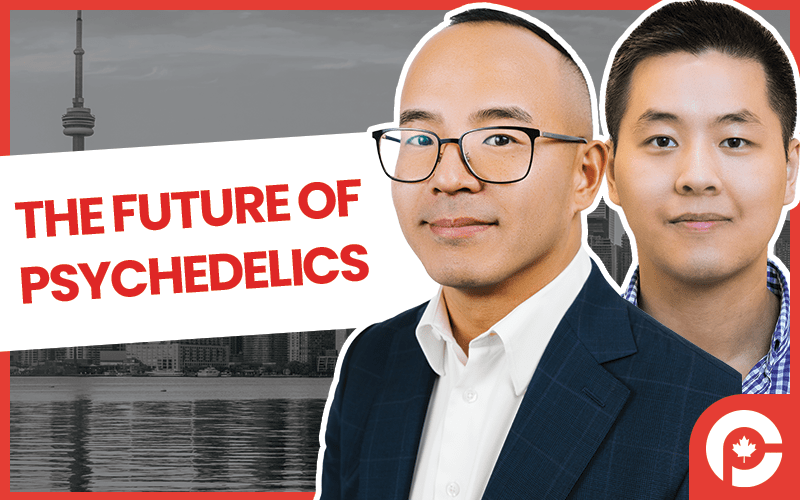
Psychedelics and the future of treating substance abuse with John Lem and Timothy Ko
Episode
Entheon Biomedical CEO Timothy Ko and John Lem, the founder of Lobo Genetics are singular in their mission to...
Key takeaways
- Psychedelics like DMT show significant promise for treating addiction and mental health disorders when administered in controlled, therapeutic settings with proper medical oversight.
- Personalized medicine using genetic testing and brain monitoring can identify which patients will respond best to specific psychedelic treatments and help avoid adverse reactions that affect 10-20% of patients.
- DMT offers advantages over longer-acting psychedelics because its 15-20 minute duration allows doctors to adjust dosing in real-time and stop treatment immediately if a patient has an overwhelming experience.
- The regulatory landscape for psychedelic medicine is shifting positively, with compounds like esketamine already approved and MDMA and psilocybin advancing through clinical trials toward potential prescription use.
- Combining multiple data sources including genetics, EEG brain monitoring, and patient history creates a comprehensive approach to match individuals with the most effective psychiatric treatments and minimize time spent on ineffective therapies.
Transcript
Full transcript page · Interactive episode
============================================================
TRANSCRIPTION WITH SPEAKERS
============================================================

[00:00] SPEAKER_00: Welcome to Candace podcast.
[00:05] SPEAKER_00: Hi, this is Celine Williams hosting from Ontario for Canada's podcast.
[00:10] SPEAKER_00: My guests today are Timothy Coe CEO of Enthion, Enthion Biomedical and John Lem CEO of Low Bo Genetics.
[00:18] SPEAKER_00: Thank you both for joining me today.
[00:21] SPEAKER_02: It's a good one to be here.
[00:23] SPEAKER_00: Absolutely.
[00:23] SPEAKER_00: I am really curious.
[00:25] SPEAKER_00: I love when I have two guests just for the record because it's always a fun flow of a conversation.
[00:29] SPEAKER_00: But I'm really curious to hear from each of you kind of your journey to get to where you are today and what you're doing in the world.
[00:39] SPEAKER_00: And then as part of that, you can tell us a little bit about what you are doing in the world and explain a little bit about what you know what you're up to.
[00:45] SPEAKER_03: Yeah, totally.
[00:47] SPEAKER_03: It's hard for me to describe what Enthion does without getting into my personal story.
[00:52] SPEAKER_03: For me, Enthion is sort of a reaction to a sort of a medicine that existed within the world as it pertains to addiction medicine.
[01:02] SPEAKER_03: I had a brother that was a multi decades long drug user for over the course of about 20 years.
[01:07] SPEAKER_03: He suffered from a variety of drug addictions principally opiates and and vitamins as well as other sort of stimulants.
[01:16] SPEAKER_03: And yeah, over the course of those two decades, we really did try to get him all of the help that was medically available to him spending hundreds of thousands of dollars, thousands of hours and psychiatrist offices.
[01:28] SPEAKER_03: And yeah, about three years ago, I became acutely responsible for his care as my parents just didn't know to do anymore.
[01:35] SPEAKER_03: And over the course of about, I guess that was four years ago, about the two years that I was his primary sort of care contact.
[01:43] SPEAKER_03: It was a bit of a case study in terms of like the limitations of a conventional drug treatment models that exist using about five or six different drug treatment centers.
[01:53] SPEAKER_03: Methodones, a box and all variety of other mental health medications like anti psychotics, anxiolytic, anti depressants.
[02:02] SPEAKER_03: And none of it sort of in totality combined or in separate pieces combined with mental health practitioners.
[02:11] SPEAKER_03: None of it had the effect that was desired and rather they're just treated the symptomology of his condition and made it so that he didn't really have access to that so that inner, I guess, narrative that inner wisdom that's so necessary in unlocking some of these answers about, hey, why do you tick the way that you tick.
[02:29] SPEAKER_03: And I guess over the course of that period, you know, his state worsened and we actually lost him to an overdose in March of 2019.
[02:40] SPEAKER_03: And so that was really difficult and, you know, in reaction to that, there was just the sense that there had to be something better, you know, better than what was available.
[02:49] SPEAKER_03: And I think the huge death count of sort of drug related deaths experience in Canada over the course of the pandemic is indicative of the reality that there aren't really good options for people that are suffering from substance use disorder.
[03:03] SPEAKER_03: And so there was almost rumbling about psychedelics and from personal perspective, I'd use them to to help improve my life.
[03:12] SPEAKER_03: And so, you know, we made it our mission to really seek out the knowledge, the knowledge keepers in psychedelic space and say, hey, you know, the transformational power of psychedelics, everyone's talking about it.
[03:23] SPEAKER_03: Is there an application for people that are suffering from addiction issues and the answer was very quickly and resoundingly yes, the transformation potential psychedelics, you know, as it applies to people that are suffering from, you know, end of life anxiety or from depression issues.
[03:39] SPEAKER_03: There's a internal core kernel of significance of profound internal meaning that is, you know, essentially operative in people suffering from addiction related issues.
[03:51] SPEAKER_03: And so pretty quickly we went from confirmation of hey, can psychedelics help people to, you know, hey, what is the best way to administer this and what's the best molecule.
[04:01] SPEAKER_03: So ultimately we arrived at DMT for the purpose of treating addiction. And that's what anti-uns core focus is is research and developing ways to administer DMT, di-methyl trip for me for the purpose of treating addiction.
[04:15] SPEAKER_03: But then going beyond that, I think we'll get into it with John going beyond just this notion of psychedelics as this panacea to treat any and all conditions, but actually really diving into, you know, what makes an individual or so unique.
[04:30] SPEAKER_03: So it's to, you know, not just, you know, blanket them with any substance, but really dive into the personalization components and capsulate and things like genetics and sort of neuroimaging to really develop a personalized treatment program to ensure that we're capitalizing on these, you know, these brave people that are taking this opportunity of willingness to see treatment and to get well really wanting to capitalize on that opportunity moment and deliver a personalized form of care that is most likely suited to
[05:00] SPEAKER_03: treat them effectively. So yeah, that's where I come from.
[05:05] SPEAKER_00: So thank you for sharing all that. I am sorry to hear about your brother, obviously. And I think I love that I love the personalized lens that you've taken inside of this and that your company's really focused on.
[05:18] SPEAKER_00: Because I think that and John, I'm going to I definitely want to hear your story. I would I just want to acknowledge I think that it's that the more we can make things personal. So we are having the, you know, we get the best results there as effective as possible.
[05:31] SPEAKER_00: And I know it's super challenging inside of anything to do with health care, but there's so much value in taking that that lens of how do we make this work for the person.
[05:40] SPEAKER_00: So they have the best experience and the best outcome as opposed to what I feel like happens a lot of time, especially if you think about psychedelics in the not medical field where it's kind of a crap shoot what someone's reaction is going to be you're kind of hoping for the best and there just isn't that ability to take the personalized lens.
[05:57] SPEAKER_00: So I just want to acknowledge I think that's really cool.
[06:01] SPEAKER_01: John, I'd love to hear your story.
[06:04] SPEAKER_01: So not as personal as Tim, but definitely has a personal vision aspect.
[06:09] SPEAKER_01: Global is originally founded from a conversation with another entrepreneur that just so happy to be a senior executive at Aurora, 10 this was back in 2018.
[06:19] SPEAKER_01: And they, one of their components of their business was running actually medical clinics in Canada and they were consistently noticing that around 10 to 20% of their patients were having stronger side effects than like 80% of their patient base.
[06:37] SPEAKER_01: And so you sat down and we had a discussion based on my background on genetics is there a genetic reason why this to top it and why they keep seeing this kind of 20% population that when they do see their team see or see the pain for sleep or for other conditions why they have more side effects.
[06:57] SPEAKER_01: And so that really became global genetics where right around that time, cannabis was not recreational we go yet and Canada that happened in 2019.
[07:10] SPEAKER_01: And global was originally established to create that personalized aspect to cannabis therapy.
[07:17] SPEAKER_01: And cannabis similar to psychedelics has it shifted where the scene is something that was very recreational.
[07:24] SPEAKER_01: No therapeutic purpose and it shifted into it's both recreational and there's a therapeutic aspect.
[07:32] SPEAKER_01: And so that was really how global got started and the transition into the partnership with that beyond was we had built this technology platform for personalization.
[07:41] SPEAKER_01: And we connected with Antion and they were embarking on their journey to personalized psychedelic treatment and 10 vision of creating personalization genetics and technology really brought both of us together.
[08:39] Speaker UNKNOWN: You
[08:46] SPEAKER_00: So completely based on you know that the whatever that that anti drug campaign I remember as a kid in like the 80s that was huge right like a demonized everything and we've taken so long to really see the potential in the value.
[09:01] SPEAKER_00: So I just want to acknowledge I love that that you have come together in this way that saying like hey let's really look at what's possible inside of this world and let's remove the stigma from it.
[09:14] SPEAKER_00: And to me that's you know I really appreciate this conversation for that reason I think it's important to have these conversations out in the open.
[09:22] SPEAKER_00: And especially because like there is real science behind all of this.
[09:27] SPEAKER_01: I think that's the critical point that if we start from a perspective of science and benefit to people.
[09:36] SPEAKER_01: You can kind of isolate the history of the past and focus on what good it can do because any drug can be abused right alcohol can be abused and 90% of the population in North America has a drink once a year like consumes alcohol.
[09:56] SPEAKER_01: So when you look at prohibition that happened in the 1920s and then alcohol is completely normal now right and so we I think we can't we can't understand the mistakes we're making currently unless we walk to the past and understand the history of psyched Alex and why it was made illegal and the potential benefits now.
[10:19] SPEAKER_01: So I think that's about 20 30 years ago.
[10:22] SPEAKER_03: Yeah, I think in the absence of I'm just so pleased that we're returning to the investigation of science led investigation of psyched Alex because I think one of the things that we've seen in the absence of psyched Alex is the you know as of now the conventional approaches to treating things like mental health and addiction related issues that are so happily reliant on you know on pharmacological interventions very strong therapies.
[10:46] SPEAKER_03: And in spite of this huge optionality in terms of the drug choices that exist we are still seeing this consistent uptick in you know psychiatric disorders as well as addiction and so you know to echo what john said I think there is it's it's it's high time that we're reinvesting this but you know taking that data driven that science first approach to really validate my do think it is super important to get into the weeds of the science to really present the data because ultimately we're going to take that.
[11:16] SPEAKER_03: So we are trying to change lives in a very medically necessary kind of way and so there are I know we talked about bureaucracy and so previous to this calls being this burdensome and terrible things sometimes but that bureaucracy does exist for the expressing and ensuring that the drugs that we're creating are safe and effective.
[11:36] SPEAKER_03: And so I do think we exist in this really opportune moment where we have the ability to create this amazing data to validate some of the assumptions that we have and so really excited to be sort of on that leading edge of scientific discovery.
[11:50] SPEAKER_00: So can you tell me a little bit about what it looks like like right now for the work that you're doing because as and I'm going to fully ignore this might be completely ignorant I'll fully ignore no problem sounding ignorant.
[12:06] SPEAKER_00: I'm not a guest and acknowledging that this might be an ignorant question but you know as far as I know psychedelics are not legal whether it's in a medical you know whether they're being prescribed which I don't think they can be because they're not legal as far as I know that's my understanding they are not legal so how does this work like what is it that you like what does this look like for you what does the future of this potentially look like I'm really curious because
[12:35] SPEAKER_03: to me I'm like I don't know I just don't know how it would work totally yeah no that's it and it's a lot has happened and a lot is happening since you know a few years ago one of the things that we do the wind in our sales is you know I think there is a perspective change in terms of these things that were once villainized and just are vilified and said oh no therapeutic value just purely for the purposes of you know potential ability to do that.
[13:04] SPEAKER_03: I'm not going to be used indicative you know looking at through the lens of addictive potential some of the work that's been done recently over the course of the last decade or so has seen a revision of some of those perspectives there recently we've had the full approval of a ketamine variant called a scatamine that has gone through full suite of approvals and is now ready for prescription that is available for prescription for the purpose of treating depression as well some off label usage for other mental indications.
[13:31] SPEAKER_03: And we are seeing the progression of some previously you know similarly vilified substance such as MDMA and civil side and they're moving their way through the regulatory process in various stages in phase two and phase three and so you know that bureaucracy that we referred to before it exists and it is sometimes an arduous cost intensive hindrance but from perspective of regulators there is still a very good way to do that.
[14:01] SPEAKER_03: So seemingly unbiased framework to submit drugs into and so you know we are leveraging this classical drug discovery and serratory pathway that is maybe not so informed by some of the historical biases of the past at least we're seeing a shift in perception that is indicating that there's a really increased willingness to investigate these things or to evaluate these things and that being case you know what that process is reliant on is acting as a way to do that.
[14:31] SPEAKER_03: So the academic rigor scientific rigor and the presence of very clean and understandable data so companies like ours as well as a variety of other companies are leveraging that system to enter into clinical trials these various psychedelic compounds for the purpose of treating a variety of mental indications and so that goes to the normal course of safety and efficacy trials and the work that we're doing we have a clinical trial plan for Q4 of 2021 extending into 2022.
[15:01] SPEAKER_03: So that is looking at that safety, safety component of dimethyl trip to mean and then you know the natural course of business will take us to subsequent trials.
[15:13] SPEAKER_00: So and John this might be a question for you I'm not sure but I'm curious when we talk about you mentioned the like personalizing let's call it of the of the experience and there's a genetic component inside of this so what is that I mean I'm going to assume and I might be wrong again totally fine if it's not going to be a good example.
[15:31] SPEAKER_00: So I'm going to assume you're not saying let me take your genetics lean and I'm going to create a completely customized drug for you I assume that's not if it is very cool but you know in light of that probably being unlikely because it would be expensive and time consuming what is it what is it actually mean to have this genetic component and to have a person have it be more personalized.
[15:55] SPEAKER_01: So that's a great question so I think it really is in two buckets one is a short term impact and the one is a long term impact so the short term impact is your sensitivity or metabolism to the drug.
[16:09] SPEAKER_01: So this is a well established area of medicine or personalization where depending on your genetic profile you can metabolize a drug differently than the person next to you and you can have a slightly different reaction or potentially a stronger reaction depending on your genetic makeup and then the second part of it which is the long term aspect is is there parts of your genetic makeup that expose you potential long term risks.
[16:39] SPEAKER_01: So if you think about the discovery and treatment of schizophrenia psychosis there is a underlying genetic basis for that that's certain percentages of the population is not a very large percentage but it is statistically significant in the one to five percent they are predisposed to psychosis or schizophrenia and then in terms of the metabolic side or the sensitivity side.
[17:05] SPEAKER_01: Again that's not a huge percentage of the population but it is still significant it can be like five to 10 percent of the population so one out of every 10 are one of every 20 people that you end up dosing with certain drugs they can have a more strong reaction to it.
[17:20] SPEAKER_01: As the as the clinical trial where we're starting our eventually hopefully clinicians prescribe it that empowers both the individual and the clinician with that information make better decisions.
[17:33] SPEAKER_00: Got it really interesting so if we I don't know if this is the you know is the next step beyond see clinical trials coming up that seems like it's kind of the next step of this and are they you know are they specifically focused on well I guess so I guess here's the question is this really about
[18:03] SPEAKER_00: what you're doing I'm sure there's lots of things and out in the world it's not I know this is a big space and I you know I am aware that there are lots of people exploring these things in different ways.
[18:15] SPEAKER_00: Is your focus really on is with the next step you really focusing on various like addictions specifically is it more about treatment of other mental health disorders that people might have it is a combination how would that work because it feels like
[18:32] SPEAKER_00: external lens I'm not in your world but it feels like it could be a lot to take on you know this world of like mental health plus psychedelics plot like it feels like oh this is a this is big.
[18:47] SPEAKER_03: No it's a it's a really great question and it is I think an accurate analysis of the psychedelic space you know there are a lot of companies proposing to treat a huge spectrum of second disorders.
[19:00] SPEAKER_03: And the unsfocus is primarily on addiction related issues so our first I have a dog running around here this is this is podcasting real life.
[19:09] SPEAKER_03: And then this is a pandemic podcasting right we have dogs and clones running around all over the place and the unsfocus is on addiction our first trial is a safety trial but there is also inclusion for healthy smokers to see if there's a quit smoking signal included within that group.
[19:25] SPEAKER_03: And then subsequently with as it relates to DMT and DMT related molecules we're going to be exploring efficacy of treating a variety of each each addiction population is unique the OP addiction population has unique inclusion.
[19:39] SPEAKER_03: Exclusion criteria separate then alcoholism population so on the DMT drug discovery side we are going to be exploring on multitude of efficacy trails.
[19:49] SPEAKER_03: And that's that's one component of the business the other component as John and I have been speaking about is this notion personalization right for us personalization will certainly help inform how DMT is administered but included within the genetics tests that's commercially available now is inclusion for not just serotoner to psychedelics to which DMT and still Simon and things like that exist there is also inclusion for ketamine.
[20:15] SPEAKER_03: And so some of the investigational work that we're doing is to sort of validate the utility of these different metabolism biomarkers as well as mental health risk factor biomarkers not just in the realm of DMT but also broadly across this you sort of evolving world of psychedelic medicine because ultimately we do want to create tools that are not just exclusively for the internal use of enthion but we do want to respond this evolving landscape this therapeutic landscape is developing.
[20:45] SPEAKER_03: Where there are practitioners that are currently working with ketamine they will be bringing on new molecules of MDMA and civil side and and one day DMT we want to make a series of tools that has I guess fulfills a duty of care as I mentioned to those people that are brave enough to seek out help seek out therapy we want to create something that has immediate utility not just for DM and the on DMT discovery but before the therapist or practitioner that is on the ground and about to go to the next level of the DMT.
[21:15] SPEAKER_03: So they will be a minister something there's a very important choice and that choice would become more complex over the course the next few years as new molecules come online as someone comes in the office and presents with a series of psychiatric symptoms.
[21:27] SPEAKER_03: The choices will be hey is it ketamine is it still siphon is it DMT and depending on how you cut certain issues some people presume that addiction is underpin by a PTSD indication so there are going to be a variety of on label usages for these medications as well as a variety of off label usages and so we think that there's an opportunity as well as an obligation for a company to come in and to help make that prescribing physicians job that might be a good example.
[21:57] SPEAKER_03: It's not much easier so that that patient that is maybe for the first time maybe for a very limited window willingness saying hey I want to get help that we make use of that experience and not subject them to many months of fail treatments and so hopefully that answers your question that it the business is thought of almost in two parts that ultimately do integrate personalization as being this sort of broadly utilitarian thing that we're trying to develop for the industry as it develops and then that will of course sort of dovetail
[22:27] SPEAKER_00: with our DMT really discoveries specific to addiction. Yeah no that's that is actually super helpful because it does it does feel like a like a taken on the world.
[22:40] SPEAKER_01: Yeah, Tim hasn't even explained the other partnership that he has with another tron based company in ECG brainwave monitoring that's like a whole other personalization and try to understand at a you know at a signaling level of the brain how the brains act the big in real time they sounds like it all but yeah I'll attempt out about that as well because that's another thing I've got empty on tour.
[23:01] SPEAKER_03: It's a big male certainly but you know all things can be eaten one by the time and so of course there is a core importance to developing at our you know we believe the DMT is the ideal molecule for psychedelic therapy unlike longer form psychedelics like ayahuasca or psilocybin or LSD where the time of engagement is anywhere from six to eight to twelve hours depending on the level and as well as metabolic factors.
[23:25] SPEAKER_03: DMT is actually a very profoundly intense molecule that could be modulated to arrive at a similar effect type or effect intensity as all of those other aforementioned molecules but it does so in a way that the due to the pharmacokinetics of it the active half life or the sort of window of experience anywhere from 15 to 20 minutes so in these long form psychedelic experiences ranging from anywhere from six to twelve hours you know as we're dealing with in a hand.
[23:54] SPEAKER_03: It's a very inherently profound sometimes challenging subject matter whether it pertains to traumas suffered as a child or through our development.
[24:02] SPEAKER_03: This is inherently difficult stuff to deal with and sometimes it can be overwhelming to the extent that becomes medically necessary to intervene right now with those longer form psychedelics there is no meaningful way to intervene to cease that experience and there is no way to titrate that dose once it's ingested.
[24:20] SPEAKER_03: DMT on the other hand once you know the way that we're delivering it is intravenously if an individual happens to have one of those intense experiences we can titrate the dosage bring the intensity down or stop it entirely for going the need for heavy sedatives or anxiolytics so that's one side of things the DMT is a uniquely modulable controllable customizable type of drug delivery.
[24:48] SPEAKER_03: But then on the other side of things as John mentioned there's certainly a lot that goes into understanding the personalization characteristics genetics is certainly one thing and we're finding that metabolism is going to be indicative potentially of whether an individual has a two week response or a two strong response that ultimately could lead to a non efficacious type of experience but we're also understanding that each individual so I think of it as genetics represent what nature has to be.
[25:18] SPEAKER_03: This is your basic coding this is the likelihood that your body will present with these types of physiological reactions there is also component that I like to characterize as nurture where over the course of your development into adult life you do take on specific brain architecture as characterized and as visible through things like electron cephalogram egs a very lightweight real time way of measuring brain activity and we are seeing that there is potential to be a very strong response.
[25:48] SPEAKER_03: So we're going to make assessments as to an individual cognitive function there are based phenotypes you know there are different just in the same way they're different personalities you might have more introverted people more extroverted people we do see that there are existing brain phenotypes that are more or less receptive to different types of psychiatric interventions as well as more or less receptive to different drug interventions and so as John is looting to it can get quite large but we're going to be able to do that.
[26:18] SPEAKER_03: The fact that we're taking is we're taking indication and molecule specific approaches to investigating this we're currently working on some research studies in the world of ketamine looking at both genetics as well as EEG to better characterize you know what is the I guess divergence or variability in these different patient populations that are going into ketamine therapy to see what the differential response will be from things like ketamine
[26:46] SPEAKER_03: while being dictated by the metabolic differences that are indicated by some of the biomarkers that we're picking up so you know it is quite a large undertaking but we are taking it bite size or one project of time trying to get a really granular understanding of what how different brains and different genotypes respond to these different drugs.
[27:11] SPEAKER_03: So ultimately a massing this massive catalog of knowledge that will hopefully go back into this predictive platform that will ultimately make a physician's job that much easier in terms of assessing and sort of customizing therapeutic designs for individuals.
[27:28] SPEAKER_00: So at some point in the future is this maybe totally way off base but is this something that could potentially become like a 23 in me but for psychiatric use or whatever the case may be where there is some sort of test where it's like I mean if you've done 23 in me you know they tell you like here's your kidney disease pyruvate whatever like they give you this list of all these genetic markers half of what you're like I don't know what that is.
[27:57] SPEAKER_00: But really interesting right so is this something that at some point I'm not saying it would be come through 23 in me but where it is seemingly that simple to take some blood of a patient send it in get the genetic markers that the psychiatrist or the treating physician can look at that and go okay based on this here's what could potentially be the best outcome so it actually does become that personalized maybe.
[28:24] SPEAKER_00: Good head there I think.
[28:26] SPEAKER_00: I think you're both like nope that's not the thing.
[28:29] SPEAKER_01: They want to see me they have some interesting more I guess insights like when we justparagus how does it even smell like what's your coffee sensitivity.
[28:42] SPEAKER_01: That's more at a vinciist I already can tell if I'm sensitive coffee just by drinking coffee right but in terms of psychedelics well there's no psychedelics can only be used that therapeutic setting and clinical trials are medically right now.
[28:57] SPEAKER_01: So I think it's a lot more personalized in the way that that algorithm that Tim refers to which can be brainwave monitoring which can be genetics which can be specific molecules.
[29:09] SPEAKER_01: That is not 23 me.
[29:11] SPEAKER_01: I mean 23 me is not intended to go to that level of personalization for sure lots of examples in the medical community where they do this all the time like for example cancer medications now there's a lot of cancer there's some specific cancer drugs is you must do a genetic test before we give it to.
[29:28] SPEAKER_01: If you have a certain profile the drug will just not respond.
[29:33] SPEAKER_01: And so they don't want to give you hundreds of thousands of dollars on medication and get your hopes up on a drug that has a world probability of responding.
[29:41] SPEAKER_01: And so because mental health it's an art not a science because it's the brain.
[29:47] SPEAKER_01: We're pulling in all sorts of data points whether it's genetics whether it's brainwave monitoring whether it's therapeutics and it's if they're all Tim said it's like pixel shovels for the condition to actually come up the right treatment.
[30:01] SPEAKER_03: And data is one thing but I think there's an importance to how that data is packaged and interpreted I think you know if you were to just look purely the genetics it's it's a very detailed oriented and data intensive type of analysis but I think there's a there's an importance to the interpretation the packaging of that data that ultimately does get to a clinically useful answering complete useful question so genetics are we think a super
[30:31] SPEAKER_03: valuable source of insight but you know we do want to provide the most comprehensive base of information that we can have two dogs running around.
[30:41] SPEAKER_03: It's great real life real life I know pandemic podcasting no absolutely data is so important so we're trying to take a multi tiered approach to data you know genetics certainly tells a very comprehensive story but we think that that could be supplemented by the real life lived reality that is presentable through electron
[31:00] SPEAKER_03: and several grams so ultimately you know as John mentioned you know within the world of oncology there is already precedent set as to the you know suitability appropriateness of certain drug prescriptions we think that within the world of psychedelics and mental health in general there is a similar urgency or need for precision because you don't really want to squander that opportunity you know mental health issues can be oppressive to the point that it is.
[31:30] SPEAKER_03: It becomes that the existential conditions of living feel almost as though they're not worth sort of suffering through and so for that person that is at that decision point of wanting help you know understanding that you know a day lived in depression or they lived in addiction is sometimes quite agonizing you know extending the sort of extent of that suffering is something that we try to minimize as much as we can and we think that taking a very informed data focused approach will
[32:00] SPEAKER_03: arrive at you know likely likely efficacious solutions earlier.
[32:05] SPEAKER_00: Fantastic. Where can our listeners go to find out more about what you are up to in the world and about you as well as humans?
[32:15] SPEAKER_03: Yeah please I encourage anyone that is interested in what we're doing to visit us at MDion biomedical.com also halogen.com and encourage everyone to you know as is as is typical these days sign up for socials you know we have so many really interesting and we think very
[32:35] SPEAKER_03: noteworthy and scientifically relevant things in the works. We encourage everyone to sign up for a newsletter to be really in the stream of that information as we develop it.
[32:45] SPEAKER_03: We are working on some amazing things and trying to help a lot of people so we encourage everyone to sign up and get in the stream of that.
[32:54] SPEAKER_00: Absolutely.
[32:55] SPEAKER_00: So I want to thank you both for taking the time to chat with me today it's really interesting I think this is a really valuable conversation and information for people to get about what's happening in this world of psychedelics of this these sorts of alternative alternative let's call them but you know alternative from what we tend to think of mainstream treatments because it's the future of medicine and it's the future of you know biotechnology.
[33:22] SPEAKER_00: Like there's so much happening here and it's it's really cool so thank you both for taking the time to chat with me I appreciate it.
[33:32] SPEAKER_00: Absolutely and for all of the listeners and viewers thank you for listening to Canada's podcast like comment and subscribe to all our channels to get the latest podcasts from entrepreneurs across Canada.