
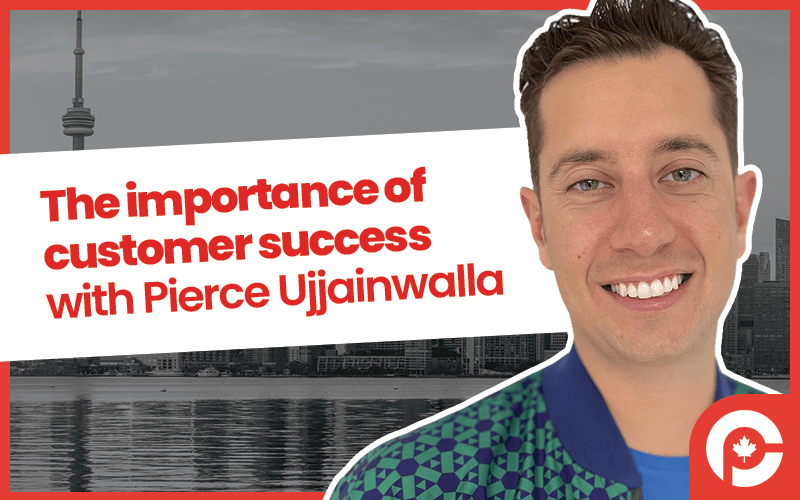
The Importance of Customer Success with Pierce Ujjainwalla
Episode
Pierce Ujjainwalla is a career marketer who has lived in the marketing trenches at companies like IBM, SAP, NVIDIA,...
Key takeaways
- Creativity is essential for problem-solving in entrepreneurship, not just for marketing but for tackling challenges across all aspects of running a business.
- Building genuine relationships and being helpful in your target community without expecting immediate sales can become one of your most powerful lead generation strategies.
- Making your existing customers extremely happy turns them into your best salespeople, which is often more effective than traditional marketing campaigns.
- Establishing core values and intentionally creating company culture from the early days is critical for long-term sustainability, even though it doesn't directly generate revenue.
- Be willing to pivot and listen to customer feedback rather than getting trapped in the sunk cost fallacy of sticking with something you've already invested time in.
Transcript
Full transcript page · Interactive episode
============================================================
TRANSCRIPTION WITH SPEAKERS
============================================================

[00:00] SPEAKER_02: Welcome to Canada's podcast.
[00:05] SPEAKER_02: Hi, this is Celine Williams hosting for Ontario for Canada's podcast.
[00:10] SPEAKER_02: My guest today is Pierce, Eugene Walla, CEO and founder of NAC.
[00:15] SPEAKER_02: Welcome Pierce.
[00:17] SPEAKER_00: Yeah, thanks so much for having me.
[00:20] SPEAKER_02: Absolutely, it's a pleasure.
[00:21] SPEAKER_02: I'd love to know a little bit about you.
[00:25] SPEAKER_02: How did you, what's, what's been your journey to get to where you're at these days and what you're working on?
[00:34] SPEAKER_00: Yeah, absolutely.
[00:36] SPEAKER_00: So, you know, I, I wasn't really sure, probably like most people in high school what they wanted to do when they grew up.
[00:45] SPEAKER_00: And so I decided to go into international business, sad curled and university,
[00:51] SPEAKER_00: mostly because it allowed me to go to Europe for a year and ski.
[00:57] SPEAKER_00: But through that program, yeah, it's in me at the time.
[01:04] SPEAKER_00: I discovered marketing and I think that was really the first time that I truly found my passion.
[01:13] SPEAKER_00: And so my first job at a business school was at a company called Cognos,
[01:20] SPEAKER_00: who's a business intelligence software.
[01:24] SPEAKER_00: And I got to learn from a lot of really smart people all about marketing.
[01:30] SPEAKER_00: And it was right at the beginning of marketing automation.
[01:35] SPEAKER_00: So Cognos was an early adopter of eloquia.
[01:40] SPEAKER_00: And, and that's really, I loved like marketing and technology together,
[01:46] SPEAKER_00: which was an amazing combination to me.
[01:50] SPEAKER_00: But I learned I didn't really want to work at a, at a 400,000 person company.
[01:58] SPEAKER_00: So I moved to a couple of different startups.
[02:03] SPEAKER_00: I implemented the marketing automation and technology at each of those.
[02:09] SPEAKER_00: And then I started my own consulting business.
[02:12] SPEAKER_00: That was my first like official business.
[02:16] SPEAKER_00: And quite frankly, it kind of fell into my lap.
[02:21] SPEAKER_00: I was getting, I started getting linked in messages asking if I did consulting.
[02:27] SPEAKER_00: For marketing automation software and kind of the rest of the history.
[02:32] SPEAKER_00: I ran that business for about seven years.
[02:37] SPEAKER_00: And that's where the idea for not came from what, what we learned.
[02:43] SPEAKER_00: And I learned this also at my first job out of university was that, you know, I was a marketer.
[02:51] SPEAKER_00: I don't know how to code.
[02:54] SPEAKER_00: And unfortunately, a lot of marketers need to code still.
[02:58] SPEAKER_00: And that's kind of where the idea for not came about.
[03:02] SPEAKER_00: I knew that it was always a problem.
[03:05] SPEAKER_00: But after consulting with hundreds of other companies and they were all experiencing the same problem,
[03:13] SPEAKER_00: that's where I was like, okay, this is a thing.
[03:18] SPEAKER_00: And this is a problem that needs to get solved.
[03:22] SPEAKER_00: And that's where not guts started.
[03:26] SPEAKER_02: So I want to take a step back for a second, because you said that when you were in,
[03:31] SPEAKER_02: and university in that international program was where kind of lined up that marketing was something you were really passionate about.
[03:37] SPEAKER_02: So before you got into the more, I'm going to call it tech side of thing.
[03:42] SPEAKER_02: But, you know, where you went with, not what was it that, why was it marketing for you?
[03:47] SPEAKER_02: Why was that the thing that you felt this is it?
[03:50] SPEAKER_02: This is where I want to put my time and energy.
[03:53] SPEAKER_00: Yeah.
[03:55] SPEAKER_00: I've always considered myself to be sort of a creative person.
[04:01] SPEAKER_00: And so seeing marketing where you can really see people taking and using that creativity and creating like a job out of that was really appealing to me.
[04:17] SPEAKER_00: I always did like numbers, but I'm a very visual person and it just seemed like a great outlet for my creativity and that could be used for something valuable.
[04:36] SPEAKER_02: So in moving, I mean, the world of entrepreneurship is nothing if not creative constantly because you're always creatively problem solving if nothing else.
[04:50] SPEAKER_02: So I imagine that that comes into play a lot with running a business.
[04:56] SPEAKER_02: And I'm also correct me if I'm wrong. And I'm also curious how that has translated into what you do with NAC now because it's not consulting and marketing, which probably to a lot of people feels like that's where it would be more creative because you get to, you know, but together the stories and the, you know, the marketing, all of the pieces of marketing, depending what they're, you know, kind of marketing they're doing.
[05:25] SPEAKER_02: So how does how, how does that show up for you now?
[05:31] SPEAKER_00: Yeah. Yeah, I think a big part of my job as CEO is solving problems. And I think you need to be creative when you're solving problems that might not seem like the intuitive place that you would use creativity.
[05:50] SPEAKER_00: But there's so many ways of solving a problem and there's not always a right or wrong or it clearly proven way of solving something. So you have to be creative.
[06:07] SPEAKER_00: And I think using creative ways to solve problems. And maybe you want to the best parts of my current job at NAC is that that's exactly what our software empowers.
[06:19] SPEAKER_00: Empowers marketers to do which is use their creativity. And that is super fulfilling for me, just knowing that all of our collective efforts at the company are helping others to be creative.
[06:37] SPEAKER_01: So how does NAC help a marketer be creative?
[06:45] SPEAKER_00: So I think that really goes back to what I mentioned about the coding and how a lot of marketers needed to know how to code.
[06:57] SPEAKER_00: So I remember when I got my first job at Cogniz, like I had so many ideas and things that I wanted to do.
[07:07] SPEAKER_00: And my job was to put together like the promotional emails and landing pages.
[07:15] SPEAKER_00: And even though we had like the best marketing automation software, I couldn't do any of the things I wanted to do because it required me to code in HTML and CSS.
[07:31] SPEAKER_00: And so with NAC, what we allow people to do is you don't need to know any of those coding languages. You don't need to know any code.
[07:42] SPEAKER_00: But you can take your ideas and build what is in your head into a reality.
[07:52] SPEAKER_02: So forgive the comparison, but is it, you know, I think a lot of people who are entrepreneurs, especially if they're early on in the journey of entrepreneurship have looked at things like square space to build a website.
[08:09] SPEAKER_02: Is it that kind of idea where it's, I know there's a word for it. I just can't remember what it is right now where it's designed so that you theoretically, at least in their case, don't have to code at all.
[08:23] SPEAKER_02: You can just kind of drag and drop and move things around so it looks the way you want it to look.
[08:28] SPEAKER_00: Yeah, yeah, a lot of similarities. I think something like square space builds like a website with the navigation and everything. NAC is very similar to that. I would say the different like the difference with NAC is that we're focused on email and landing pages.
[08:49] SPEAKER_00: And specifically for kind of enterprise marketers. So what I mean by that is if you're, you know, a billion dollar company, you have very strict brand guidelines that you have to follow around your colors and your fonts and what logos you can use and
[09:10] SPEAKER_00: you have to work with, you know, hundreds, sometimes of people to get a single asset of the door.
[09:18] SPEAKER_00: And so we've really taken that approach of like, how do we help the biggest companies in the world be creative. And I know this because I was at one of the biggest companies.
[09:31] SPEAKER_00: And so I think that's the biggest challenge is there are some of the ones that have the hardest time being creative.
[09:37] SPEAKER_00: And so in that sense, I think we're solving one of the biggest challenges too.
[09:45] SPEAKER_01: So how have, how has it, I'm going to take a step back actually, when did you start NAC how long ago was it?
[09:58] SPEAKER_00: 2015.
[09:59] SPEAKER_02: Okay. So I was asking because I was, I'm earlier than that it wasn't something that started like right before the pandemic or maybe as you were trying to grow that was like a huge issue.
[10:11] SPEAKER_02: So that's why I was, so you have the context because what I'm curious about is, how have you gone about building NAC out in terms of your own business?
[10:26] SPEAKER_02: Marketing, or gaining clients or whatever the case may be. And I ask this because when we're talking about enterprise companies, we definitely have some listeners who that's what they're interested in is getting into that world in some way.
[10:41] SPEAKER_02: But if you do any work with them, which I do in consulting and you do in consulting, some of those lead times can be real long.
[10:49] SPEAKER_02: And you know, there's a lot of back and forth and, and so how did you go about managing that or dealing with that because I think it can, I know it can and I hear this all time, it feels really scary when it's even you're waiting and it's a waiting game and it's a lot of waiting game with enterprise size company.
[11:14] SPEAKER_00: Yeah, yeah, so I mean, I can share how how we did it and I think for me, so when I first got into marketing automation, I got really deep into one community.
[11:29] SPEAKER_00: So it was the Marquetto community, Marquetto is one of the marketing automation platforms and I, you know, I genuinely was super passionate about it.
[11:43] SPEAKER_00: And I think my passion, other people saw my passion, whether it was speaking at their customer conferences or they had an online community where I just, I didn't even know this at the time and because I wasn't doing it for sales, but it ended up being one of like the biggest lead drivers is that I would go on the community and answer like as many questions.
[12:13] SPEAKER_00: As I could, because I genuinely wanted to be helpful to other people, but in turn, everyone got to know who I was and I built a bit of a, you know, name for myself on the rich eventually translated into consulting customers.
[12:34] SPEAKER_00: So sometimes it's not the most intuitive things are like a marketing gimmick or campaign, but I think that if you genuinely try to be helpful in a community of people that you're trying to sell to that people really appreciate that.
[12:56] SPEAKER_00: And the other thing that I learned and this is mostly for my first company in the consulting space was that the best way to get customers is to make other happy customers.
[13:13] SPEAKER_00: So we were hyper focused on our NPS score and making every customer that we did have like a raving advocate for us and that that is still the case that not I think if you have your customers are your best sales people.
[13:38] SPEAKER_00: And we really took that to heart.
[13:41] SPEAKER_02: I really appreciate that.
[13:44] SPEAKER_02: What you shared around answering questions and being helpful because I think a lot of times people get really stuck in the I need to create this funnel it needs to look this specific way and if I run these campaigns and if I do these things that's how this all works.
[14:00] SPEAKER_02: And it's not to say that can't work that's absolutely not what I'm saying.
[14:05] SPEAKER_02: But there are other ways to drive value and if you're focused on driving value on you know, I think it's a lot of the content.
[14:15] SPEAKER_02: A lot of content marketing has this behind it, which is how can you give information share information solve problems and help people is when you're doing that that's when people trust you and they want to do more things with you.
[14:28] SPEAKER_02: And you kind of did that before it was a thing in a really natural way. So I appreciate you sharing that because I think it's important that people hear.
[14:39] SPEAKER_02: That there are different ways and just go by this one piece of software go do this you know create a funnel and execute it over and over again not again nothing wrong with it but it's not the only thing that works.
[14:53] SPEAKER_00: Yeah, I think sometimes the best things are the things that don't scale at all and I think yeah.
[15:02] SPEAKER_00: Yeah, like you have to do some of those things, especially in the early days, I mean, I will say up until we raise their series say in 2019 all of our business 100% of our business was inbound.
[15:18] SPEAKER_00: So people coming to our website and requesting a demo of our software and I think behind that.
[15:30] SPEAKER_00: Yeah, there was a lot of content where you're getting a lot of reading useful relevant content capturing people's email addresses emailing them about relevant things that they can benefit from.
[15:47] SPEAKER_00: But yeah, we you know, we are we drink your own champagne as we like to say here at NAC email is the big part of it digital marketing is the big part of it.
[15:58] SPEAKER_00: But at the heart of it is like really knowing our customers a lot of us were in our customers shoes before and thinking like, hey, what is something that we could make for them that would help.
[16:16] SPEAKER_00: Make their job easier.
[16:19] SPEAKER_00: Give them information to make them advance their career or just, you know, answer questions that we know that they have and yeah, it's tough.
[16:31] SPEAKER_00: And you mentioned how long it takes in the enterprise space.
[16:36] SPEAKER_00: One of our first enterprise customers at NAC is like one of the biggest pharmaceutical companies in the world.
[16:44] SPEAKER_00: They saw me speak at a market conference in 2015 and they became a customer in 2018.
[16:52] SPEAKER_00: Like that's how long it takes.
[16:56] SPEAKER_00: So don't give up keep going give it time be patient and it's so hard to be patient.
[17:04] SPEAKER_00: But I think it is necessary, especially when selling to big organizations who move who make decisions slowly.
[17:18] SPEAKER_01: Yeah, I couldn't agree more and I appreciate you sharing that.
[17:25] SPEAKER_01: I'm curious.
[17:27] SPEAKER_01: Beyond the be patient, which I think is great advice.
[17:32] SPEAKER_01: What you have learned.
[17:37] SPEAKER_02: And on your journey of being an entrepreneur both in this business, but in, you know, consulting business as well, which I recognize is a bit of a different beast.
[17:45] SPEAKER_02: But what you've learned, good or bad that you would do again or not do again, when you look back on your journey that you'd be willing to share with our listeners today.
[17:54] SPEAKER_02: Yeah.
[17:57] SPEAKER_00: Yeah.
[17:57] SPEAKER_00: Yeah.
[17:58] Speaker UNKNOWN:
[17:58] SPEAKER_00: I mean, it's not behind the scenes.
[18:01] SPEAKER_00: It's never as pretty as it looks on social media.
[18:05] SPEAKER_00: You know, you make a lot of mistakes and you have to learn from them.
[18:09] SPEAKER_00: I think one of the biggest mistakes I made with my first company is that I didn't focus enough on core values and culture.
[18:20] SPEAKER_00: Just because I didn't have the experience with it and I couldn't see how like having core values doesn't generate you revenue.
[18:32] SPEAKER_00: So it's not necessarily something that's high up on your priority was.
[18:38] SPEAKER_00: But for us, what ended up happening was that we were so laser focused on making our customers happy that we were, we didn't spend any time on how do we could, you know, how do we create intentionally create a great culture within the company.
[19:03] SPEAKER_00: And we were pretty broken inside for a little while.
[19:10] SPEAKER_00: And so when I started at NAC, after the first year, we all came together as like the first 10 NACs to us.
[19:20] SPEAKER_00: And we just shared a bunch of stories that we felt really to find us as the company.
[19:27] SPEAKER_00: And we created our 10 core values that of that.
[19:31] SPEAKER_00: And I think that it's so huge.
[19:35] SPEAKER_00: And I saw kind of what happens when you don't do that.
[19:39] SPEAKER_00: And now, you know, the flip side of it when you do it and you're intentional about your culture.
[19:47] SPEAKER_00: How it just gives you, you know, those guard rails on hiring, firing, holding people accountable and celebrating the great things that happen in a company.
[20:03] SPEAKER_02: Well, you are speaking to my heart is the, you know, the listeners here know the work that I do is all on culture and leadership.
[20:10] SPEAKER_02: So I could not agree with you more.
[20:13] SPEAKER_02: And I appreciate you saying that because I think when you're growing a company, especially early days, you're so focused on the things that drive revenue and make you money.
[20:25] SPEAKER_02: That some of the quote softer things like softer skills that we think about, we just don't put enough attention on them.
[20:32] SPEAKER_02: And long term, that's often not sustainable.
[20:36] SPEAKER_02: So I very much appreciate you sharing that because I think it's important.
[20:43] SPEAKER_01: Before we, it's not.
[20:46] SPEAKER_01: It's not.
[20:49] SPEAKER_00: It's not the most obvious thing when you're head down starting a business today. Hey, we should really think about this, but I think it is one of the most critical thing.
[21:05] SPEAKER_01: Yeah, I agree.
[21:10] SPEAKER_02: Before we wrap this up, I'm curious if you have anything that looking back, you absolutely did right and would do again in any business going forward with this.
[21:29] SPEAKER_02: And this was the game changer, you know, and something that always comes to mind for me is I heard someone say once hiring an assistant early on when I didn't think I needed it when it wasn't like, you know, it wasn't someone out selling and making money.
[21:48] SPEAKER_02: That freed up my time in such a specific way that, you know, I would do that. And I'm not saying that's the thing free, but is there something that you're like this was a game changer moment that I didn't necessarily, you know, no, it was going to be.
[22:04] SPEAKER_00: I think for us like our first product that Mac with this is actually like our second iteration of our product, our first product that Mac was a completely different way of tackling the problem.
[22:25] SPEAKER_00: And there was a time where we really had to decide like do we keep going with this initial product or do we pivot and listen to our customers feedback and build something new to address it.
[22:42] SPEAKER_00: And I think that was that was really our big turning point. If it could have been easy to just be like, no, we've invested too much in this first product.
[22:53] SPEAKER_00: We're going to grind it out. We're going to see where it goes. But I think listening to your customer feedback and being ready to throw things out that you might have worked a long time on.
[23:10] SPEAKER_00: Like not getting caught in that time fallacy is a big was a big turning point for us. And I think is one of the most important things we did.
[23:25] SPEAKER_02: Thank you for sharing that. I think that changes is so challenging. And even when it comes from feedback, a lot of times people want to avoid it as much as possible for various reasons.
[23:37] SPEAKER_02: And so I appreciate you sharing that. I think it's a really important lesson for people to hear.
[23:43] SPEAKER_02: For those listening, you can learn more about Pierce at knack.com. That's K and a K.com are on LinkedIn. There will be links in the show notes. Cheers. Thank you for joining me today. I really appreciate your time and this conversation.
[23:58] SPEAKER_00: Yeah, thanks so much for having me on.
[24:01] SPEAKER_02: Absolutely. And for those listening, thank you for listening to Kans podcast, like, comment, and subscribe to all our channels to get the latest podcasts from entrepreneurs across Canada.