
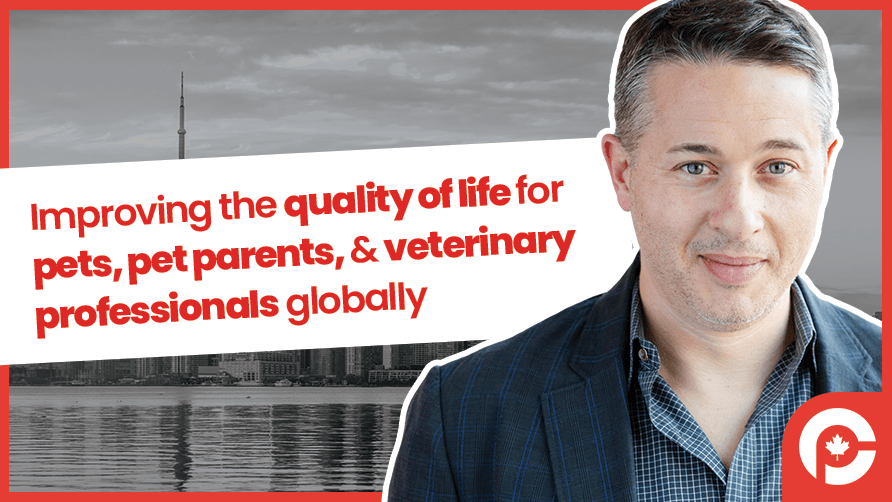
Using technology to improve the quality of life for pets, pet parents, and veterinary professionals globally
Episode
Mark Bordo is the co-founder and CEO of Toronto-based Vetster, a telemedicine service for pets. Taking his 20-plus years...
Key takeaways
- Execution and having a clear plan matters far more than the idea itself, as any idea can succeed with proper execution and your initial concept will evolve significantly over time.
- Consistency and persistence are essential entrepreneurial traits, requiring you to show up with the same energy and effort every single day regardless of highs or lows.
- Pet telemedicine works effectively because proper communication of symptoms allows veterinarians to provide the same quality care remotely as they would in-person for most non-emergency cases.
- Virtual veterinary care complements rather than competes with traditional clinics, with the ideal approach being to have both a brick-and-mortar vet for serious issues and a virtual vet for day-to-day care and after-hours access.
- Maintaining an even-keeled approach to entrepreneurship is crucial, as you must expect challenges to come and avoid riding emotional highs and lows to sustain long-term success.
Transcript
Full transcript page · Interactive episode
============================================================
TRANSCRIPTION WITH SPEAKERS
============================================================

[00:00] SPEAKER_01: Welcome to Canada's podcast.
[00:05] SPEAKER_02: Hi, this is Celine Williams hosting from Ontario for Canada's podcast.
[00:09] SPEAKER_02: My guest today is Mark Bordeaux, who is the co-founder and CEO of VETSTER,
[00:13] SPEAKER_02: a telemedicine service for pets.
[00:16] SPEAKER_02: Taking his 20 plus years of experience as a tech entrepreneur
[00:18] SPEAKER_02: and his own personal experience as a dog owner,
[00:21] SPEAKER_02: Mark has developed a unique platform that is improving the quality of life for pets,
[00:25] SPEAKER_02: pet parents, and veterinary professionals globally.
[00:28] SPEAKER_02: Welcome, Mark.
[00:30] SPEAKER_01: Thank you for having me. Really nice to be here, Celine.
[00:33] SPEAKER_02: Absolutely. It's a pleasure.
[00:34] SPEAKER_02: So I, as a pet owner, I love this idea just for the record as the owner of cats,
[00:40] SPEAKER_02: which often appear in these videos.
[00:43] SPEAKER_02: I love the idea of what you're doing, and I'm curious your journey to getting here.
[00:48] SPEAKER_02: What, in those 20 plus years, how did you, what did that look like to get you to VETSTER today?
[00:58] SPEAKER_01: So I've been an entrepreneur for, as you mentioned, for probably over 20 years now,
[01:03] SPEAKER_01: specifically focused in the marketplace tech space.
[01:08] SPEAKER_01: So I've been building marketplaces for more than 20 years,
[01:12] SPEAKER_01: and different types of marketplaces.
[01:14] SPEAKER_01: One was in home improvement.
[01:16] SPEAKER_01: The other was in vacation rentals.
[01:18] SPEAKER_01: And what led me here at VETSTER is still not saying marketplace tech vertical.
[01:24] SPEAKER_01: Which I find incredibly interesting.
[01:28] SPEAKER_01: But through my own personal experiences, essentially of being a dog owner for now,
[01:32] SPEAKER_01: my whole life, but my own dog is 15 years old Riley.
[01:38] SPEAKER_01: And just in watching some of this struggles and challenges that she faces in getting pet care,
[01:44] SPEAKER_01: and that I face as a busy person in bringing her to the VET clinic,
[01:49] SPEAKER_01: post a lot of challenges.
[01:51] SPEAKER_01: And so one thing led to another, and a few years ago,
[01:56] SPEAKER_01: started to think about human telemedicine, and then wondered why I couldn't be bringing my pet to the clinic through pet telemedicine.
[02:04] SPEAKER_01: And that was really the genesis of the idea.
[02:08] SPEAKER_02: So you mentioned marketplace tech, a couple of times, or some version.
[02:13] SPEAKER_02: I might've got the language wrong.
[02:15] SPEAKER_02: Can you explain what you mean by that?
[02:17] SPEAKER_02: Because my guess is that there's a lot of people listening or watching who are thinking,
[02:22] SPEAKER_02: isn't everything a marketplace?
[02:25] SPEAKER_01: Yeah, so I probably use that term loosely.
[02:27] SPEAKER_01: But the way that I view marketplaces is essentially, can you take two different groups
[02:33] SPEAKER_01: and connect them on a platform for any type of transaction?
[02:38] SPEAKER_01: So in this case, we're matching pet parents.
[02:41] SPEAKER_01: And at VETSER, it's very neat to say that when you think about what a pet parent is,
[02:47] SPEAKER_01: automatically we go to cats and dogs, but we treat over 20 different species of pets on the platform.
[02:53] SPEAKER_01: So guinea pigs and birds and reptiles and hamsters, and of course cats and dogs.
[03:00] SPEAKER_01: And so we're matching those pet parents with veterinarians.
[03:03] SPEAKER_01: And so, and allowing them to transact in a telemedicine appointment on the platform.
[03:08] SPEAKER_01: So that's how it would define marketplaces, it relates to VETSER.
[03:14] SPEAKER_02: So I have a couple of more specific questions, but I want to start with a slightly more broad one,
[03:20] SPEAKER_02: which is what is the, what is it that's appealing to you about the,
[03:26] SPEAKER_02: this kind of marketplace, the way you're defining it, tech that you've been in,
[03:29] SPEAKER_02: since you've done it a few times, like what is the, what is excites you about that?
[03:38] SPEAKER_01: The technology behind marketplaces has evolved dramatically over the last 20 plus years.
[03:46] SPEAKER_00: And it's a real science.
[03:48] SPEAKER_00: It's something that is, takes a great deal of experience to run optimally.
[03:57] SPEAKER_01: And if it's not run optimally, it can be extremely expensive.
[04:00] SPEAKER_01: And I think, when I think about that question, it's more so about building on the experiences that I've had,
[04:09] SPEAKER_01: and not wanting to, let's say, you know, it changed direction into something completely new when my career has been evolving alongside of marketplace technologies.
[04:20] SPEAKER_01: And so, when I think about companies or building new companies using that experience,
[04:27] SPEAKER_01: it's one major advantage that I have.
[04:30] SPEAKER_01: And it's, again, what has led me to, to build Vestor in this way is not wanting to stop that experience,
[04:40] SPEAKER_01: but rather keep growing with it and use it to, as a real competitive advantage in building a company.
[04:47] SPEAKER_02: Cool. So thank you for sharing that.
[04:49] SPEAKER_02: I'm curious.
[04:53] SPEAKER_02: So I, in a previous life, when I had a corporate role, I actually worked in telemedicine, but not for the government, not as a healthcare professional, but in implementing telemedicine for humans.
[05:06] SPEAKER_02: And I recognize there are a lot of challenges that come with that in the world of humans and connecting to doctors.
[05:14] SPEAKER_02: I'm curious what kind of challenges you faced in setting this up for pets, because I imagine there are challenges there as well, just probably different ones.
[05:27] SPEAKER_00: There certainly are.
[05:29] SPEAKER_01: It's the first question I got on day one.
[05:32] SPEAKER_01: Well, my pet can't talk.
[05:34] SPEAKER_01: So how can a veterinarian see my pet?
[05:39] SPEAKER_01: And really, it's a new emerging market.
[05:43] SPEAKER_01: And the concept of telemedicine for humans and pets is still growing and is still very new.
[05:49] SPEAKER_01: And humans aren't that comfortable today, still in visiting a doctor, although it's really improving.
[05:56] SPEAKER_01: And we're seeing the same evolution for pet parents, that the notion for, to take a brand new notion, like taking your pet,
[06:07] SPEAKER_01: but one of your cats to the veterinarian right now, you'll have lots of questions about that.
[06:13] SPEAKER_01: But it's truly a magical experience when it happens.
[06:18] SPEAKER_01: And I, you know, again, getting over that hurdle of, oh, my pet can't talk and you can't put your hands on the pet, you know, and see what's going on or, or listen to certain, you know, diagnostics in person.
[06:34] SPEAKER_01: It boils down to communication.
[06:37] SPEAKER_01: And if the pet owner can communicate exactly what the symptoms are, then likely a veterinarian is going to be able to provide the same course of care that they would through telemedicine as they would in person.
[06:51] SPEAKER_01: And what I mean by that is, let's say you brought your cat in today with a suspected ear infection, you could bring your cat in and that may say, okay, that looks, smells and feels a lot like an ear infection.
[07:04] SPEAKER_01: Here's a antibiotics, hopefully it clears up.
[07:06] SPEAKER_01: But if it doesn't sleep, please come back in a week and we'll, you know, we'll have to change course.
[07:12] SPEAKER_01: Same thing is true for telemedicine.
[07:14] SPEAKER_01: And if you can properly describe the symptoms that are going on with your pet, then you can get a proper diagnosis and we've had a remarkably high success rate of resolution on the platform, and not just on investor platform, but through telemedicine in general, the data would suggest that it's an extremely effective course of care.
[07:35] SPEAKER_01: And yeah, that was always the biggest hurdle is, hey, my pet can't, my pet can't talk. I think for me, having a senior dog, I actually never questioned it.
[07:47] SPEAKER_01: It is, I go through many more hurdles, getting my animal, Riley to the vet, then I do about, can I communicate directly to the veterinarian.
[08:00] SPEAKER_01: Our investor product is also so sophisticated that now you can upload so many different types of diagnostics, be it blood work or X-rays or any, you know, a urine sample readings or anything along those lines to help the veterinarian come to the proper conclusion.
[08:19] SPEAKER_01: So, I think we've overcome a lot of those initial hurdles, but it's my long-winded way of saying that the very first question we got on day one is, hey, my pet can't talk. So how does this work? And I think this technology improves.
[08:34] SPEAKER_01: And as more people continue to try pet telemedicine, you'll see that that will be a distant memory that main question that we got from day one.
[08:42] SPEAKER_02: I find that so interesting that that's the first question because as someone who like you has the experience of taking pets to the vet, they also can't talk in person with the vet.
[08:56] SPEAKER_02: It's not like, if I'm in a vet clinic, suddenly my cats are like, oh, thank goodness. Well, here we go. That's not how it works. So the not talking piece is really interesting because they can never talk.
[09:08] SPEAKER_01: It's actually the experience is quite the opposite because if you take your experience in a vet clinic where your pet is scrambling on the table, you're hoping they don't have an accident.
[09:21] SPEAKER_01: There's 20 people waiting in the waiting room. The vet wants you out as fast as possible. Normally, you want to get out as fast as possible.
[09:30] SPEAKER_01: You're animal wants to get as fast as possible. It is not a calm experience for anybody who goes through that. But then all of a sudden, you have a conversation like we're having now.
[09:40] SPEAKER_01: And you have this incredibly educated sophisticated doctor with an amazing training who loves animals and you give them a few extra minutes to speak to you one on one in this type of environment.
[09:53] SPEAKER_01: What you find is you're going to get even a higher level of care because now they have some time. They're relaxed. There's no animal in the equation that's like running all over the place.
[10:03] SPEAKER_01: So it's not like we can sit and talk about the issue while you're here. But then we can also take a few minutes and say, Hey, Celine, what are you feeding your cats?
[10:09] SPEAKER_01: When was the last time you talked about nutrition? Let's have a conversation about how we can get proactive about some of their care.
[10:16] SPEAKER_01: And those types of conversations are happening all the time through pet telemedicine on the vet's platform that don't necessarily happen in clinic because of some of the other hurdles that that you have to sort of overcome.
[10:28] SPEAKER_01: So I would in fact say that the experience for the cases that hit telemedicine are, you know, have an advantage over those same cases going into clinic.
[10:43] SPEAKER_02: So how does if I'm a consumer as a consumer, because I am a consumer, that's not a theoretical as a consumer.
[10:53] SPEAKER_02: Or how would I determine if it's appropriate for me to use telemedicine for my pattern if I need to take them in clinic aside from open wounds, you know, a traumatic injury because absolutely, please always take an animal in for that.
[11:13] SPEAKER_01: Right. So I think if your animal does absolutely in some of emergency distress, that is not a time to use telemedicine.
[11:25] SPEAKER_01: But telemedicine has so many different or pet telemedicine has so many different use cases and the symptoms that we treat are vast.
[11:35] SPEAKER_01: And we think about telemedicine, it's not just the acute reasons, but it's also just proactive pet care.
[11:43] SPEAKER_01: So you can use it for telehealth, which could be, you know, why in a range of cases, everything from diet, nutrition, training, behavior, even things like end of life are conversations that you can have through pet telemedicine with a veterinarian.
[11:59] SPEAKER_01: You could be standing at the pet store and instead of looking at the color of the bags, deciding what kind of food to feed your pet, you could actually have a conversation with a veterinarian and say, what ingredients should I be looking for.
[12:11] SPEAKER_01: So those are all great things for telemedicine.
[12:16] SPEAKER_01: And then I would go to triage.
[12:18] SPEAKER_01: So the common question, what do I do? My dog is doing this, my cat is doing this, my hamster is doing this, what do I do? Do I need to go to a vet clinic or what is my next step here?
[12:31] SPEAKER_01: So any sort of triage is also great use cases for telemedicine.
[12:35] SPEAKER_01: And then the third part is the actual acute care. So when things are going on with your pet and you have general concern, or there's a general issue and it can be anything from a gastroissue to skin issues to my dog or cat ingested this or, you know, anything along those lines, eyes, ears, I mean, all of it.
[12:59] SPEAKER_01: I would go first to telemedicine to pet telemedicine before I would need to go to the clinic.
[13:06] SPEAKER_01: I would save the clinic as it's for when things are really serious and you have to, you know, your animals in complete distress and there's no way that technology can be used to solve it, a broken bonus, the perfect example.
[13:18] SPEAKER_02: I got it and I assume also things like obviously, I'm going to say that something very obvious, but like blood draws things like that.
[13:27] SPEAKER_02: You need a clinic to get involved in.
[13:30] SPEAKER_01: Well, that's very interesting because you absolutely need a clinic to do that work, but think about how we as humans go to labs and have our blood taken.
[13:42] SPEAKER_01: So your clinic is able to go to do that work and to actually get that diagnostic information, draw blood, urine, etc.
[13:50] SPEAKER_01: But then you're able to take those results and upload them to VETSTER so that you can have your veterinarian review them and diagnose the, I want to be very clear about something.
[14:03] SPEAKER_01: We're not at all a competition to clinics.
[14:07] SPEAKER_01: We are, we work in tandem with them and I think the proper care for any pet is to have two veterinarians and you have your brick and mortar clinic, your veterinarian.
[14:19] SPEAKER_01: I have a wonderful vet that vet knows exactly what I do for a living and the vet has been taking care of my dog for 15 years and when things like she has kidney disease.
[14:31] SPEAKER_01: And when things are serious with her and she needs to go on IV or need specific treatment for that, I'm going into the clinic and they're treating her.
[14:41] SPEAKER_01: But I'm also taking those diagnostics. I'm uploading them to VETSTER and my day to day veterinarian, which is a virtual vet, is managing the day to day care and is able to get me medication for my dog for the day to day.
[14:56] SPEAKER_01: This works tremendously well for my lifestyle because I can get treatment on any given day, on a weekend or when I'm traveling and I know have access to a veterinarian on my phone wherever I need them.
[15:10] SPEAKER_01: And then I also know that when things are serious, I can go into or more serious, I can go into a clinic and get the help of, you know, an in person.
[15:20] SPEAKER_01: So I think that's the movement that's happening across pet parents everywhere is to have those two vets and be prepared for both scenarios.
[15:29] SPEAKER_01: I always like to ask pet owners who say that they have a wonderful relationship with their veterinarian, which is great, but what happens at 6 p.m.? What is your plan or what is your plan on Sunday afternoon or upcoming with the holiday season?
[15:43] SPEAKER_01: What is your Christmas Eve plan? Because who knows when these incidents arise? What with VETSTER and what we've built here and the idea of a virtual vet is that you always have access to care for your pet.
[15:57] SPEAKER_02: Not it. I think that's a, I think that's important for vet parents to hear, right? Is that it's, it's a compliment. It's not a competition.
[16:08] SPEAKER_00: Also, absolutely. Yeah, absolutely.
[16:17] SPEAKER_02: So not only with VETSTER necessarily, but in the work that you've done in various entrepreneurial endeavors, that's the word I'm looking for that you've pursued in the last 20 plus years.
[16:34] SPEAKER_02: What have been the things that, what have been lessons that have come up over and over again are themes that you can see you learned and that helped you going forward that you might share with some of the listeners or things to be aware of in the entrepreneurial journey, because I think there's many highs and many lows for every entrepreneur.
[16:58] SPEAKER_01: I think you get you develop really fixed again and I believe that's you just said it. I think being even keel for those highs and those lows are is a really important lesson.
[17:15] SPEAKER_01: This is about persistence. This is a real test of like stick to it,iveness and of energy. And can you consistently deliver that energy day to day and you know overcome the lows, overcome the hurdles, overcome the objections and then eventually get to a positive outcome.
[17:42] SPEAKER_01: It's not easy. It is a real energy test. And I think if you go up and down with every high and every low, it makes it more difficult.
[17:54] SPEAKER_01: As we sit here today, it's almost like at this point in my career, you expect the lows to come. I expect the challenges. When you go through periods of time, even hours in a day where you don't have those challenges, I'm like sitting waiting for that person to walk into my office or the phone to ring to say, okay, here's the next challenge.
[18:15] SPEAKER_01: And you accept those and you solve them and you move forward and same thing with the highs. You know, the highs are great. You should celebrate them. But you very quickly need to move on to the next moment because it's fleeting.
[18:35] SPEAKER_01: So, you know, I think about that stuff, but I also think about words like consistency and persistence are two real words I would describe as like lessons learned over the last 20 years that those are two traits that I think entrepreneurs require to be successful.
[18:57] SPEAKER_02: So, how do you remain even killed? Like, what are some of the practices that you have to remain even killed inside of the ups and downs and to remain persistent and consistent?
[19:12] SPEAKER_01: Yeah, I wouldn't say it's unintentional, but I've developed a routine over the last couple of decades. And I'm very good in that routine. And it's not something that I'm even probably conscious of. It's just my routine.
[19:33] SPEAKER_01: It's a very consistent pattern of work and effort and hours spent and focused spent. And I'm very good in that routine. It's been going on for a long time. If you, if you get, if you interjecting at routine, I'm not the greatest in that moment.
[19:52] SPEAKER_01: If you came to me today, Selene, and said, Hey, Mark, let's go run out for lunch and the two of us can sit and have lunch today. That wouldn't be a normal day for me in my routine. You'd be taking up part of my focus time. And I would say you would not get the best version of myself in that moment because I'm so consistent in my daily routine that you wouldn't have my attention.
[20:16] SPEAKER_01: So I think that routine has been very important for me when I think about that routine. It's not just the hours spent, but it is the daily consistent effort within that routine that is pretty much the same every day.
[20:33] SPEAKER_01: I show up every day and I put in the same effort every day. I'm not here to like mail in a day. It's quite the opposite.
[20:42] SPEAKER_02: Got it. I appreciate the showing up repeating, sticking to it, keeping it going. I assume over the years you have adapted it and improved it whether consciously or subconsciously so it works for it continues to work for you.
[21:01] SPEAKER_00: Right.
[21:03] SPEAKER_02: Yeah.
[21:04] SPEAKER_02: Mark, before we wrap this up, is there anything that we didn't get to that you wanted to talk about or something that you wanted to emphasize from what we did talk about?
[21:15] SPEAKER_01: In these types of situations, I'm often asked the questions about, Hey, I want to start a business. Is this a good idea? What do you think about this? What do you think about that?
[21:27] SPEAKER_01: And I always like to tell people for the entrepreneur and it's a really important message.
[21:33] SPEAKER_01: Any idea can be successful relatively any idea can be successful. It's what is your execution plan and are you going to be able to execute on that plan?
[21:44] SPEAKER_01: So whatever your idea is your idea could be a wallpaper store and we want to reinvent how well paper is being sold. Awesome.
[21:50] SPEAKER_01: Go do it. But can you execute on that plan and what is the plan? How are you going to grow this business? What is you know that is the part that is more important than, Oh, hey, I have this really interesting idea.
[22:06] SPEAKER_01: And so that is to me, when you're an entrepreneur or you're considering becoming or starting your own business, it's not the idea that you need to focus on so much because the idea is actually going to change as you evolve and where you're starting with that idea is going to completely change over weeks, months, years as you build your business.
[22:28] SPEAKER_01: It is can you show a plan of execution and then operate that plan that if you can do that then go build any business you want.
[22:39] SPEAKER_02: I love that and I think that that is really important message to emphasize at the end. So thank you for bringing it up because it is execution is the key.
[22:49] SPEAKER_02: That's what it comes down to.
[22:50] SPEAKER_02: Thank you. So Mark, thank you for being my guest today. I appreciate getting the chance to chat with you and know you a little bit better and the time that you spent with me. So thank you for that.
[23:02] SPEAKER_00: And time. Yeah, thanks for.
[23:04] SPEAKER_02: Absolutely. And for those listening or watching, thanks for listening to Canada's podcast, like comment and subscribe to all our channels to get the latest podcast from entrepreneurs across Canada.