
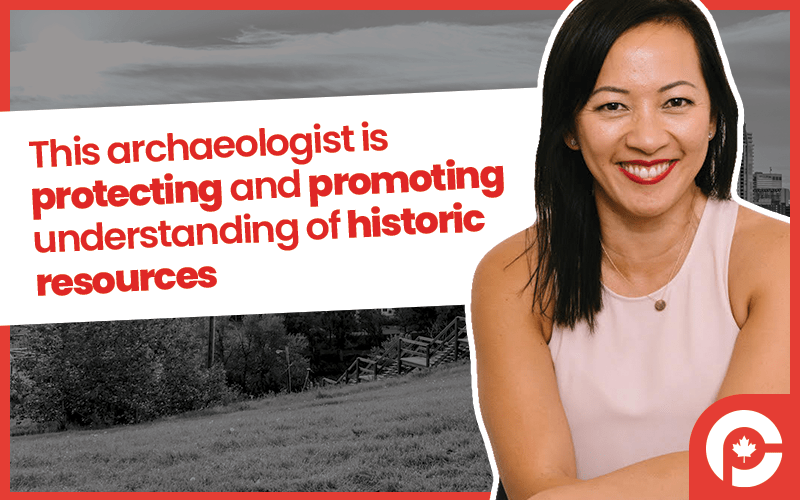
This Archaeologist is Protecting and Promoting Understanding of Historic Resources
Episode
Margarita de Guzman is one of very few female archaeologist entrepreneurs in Canada, and she just launched a program...
Key takeaways
- Learning from the past is essential for moving forward, as all technological advancements come from understanding previous mistakes and building upon them.
- Being present and working hard are fundamental requirements for business success, but the people aspect of leadership is often the most challenging part to master.
- Supporting women in male-dominated industries requires intentional programs including mentorship, networking opportunities, and resources to help them stay in their careers long-term.
- When running a business, relationships often disappear first, so it's important to be purposeful about maintaining connections with friends and family despite the demands of entrepreneurship.
- Contributing to reconciliation and indigenous inclusion means creating real opportunities for indigenous participation, spending, and ensuring their heritage is properly interpreted and honored.
Transcript
Full transcript page · Interactive episode
============================================================
TRANSCRIPTION WITH SPEAKERS
============================================================

[00:00] SPEAKER_00: Welcome to Canada's podcast.
[00:05] SPEAKER_00: Hello, I'm Mario Tonoguzzi with Calgary's podcast on Canada's podcast network.
[00:11] SPEAKER_00: Joining me today is Margarita Deguzman, who is managing director of Circle CRM group in Calgary.
[00:19] SPEAKER_00: Thanks for joining us today, Margarita.
[00:21] SPEAKER_00: Thanks for having me.
[00:23] SPEAKER_00: Well, tell me a little bit about yourself and what your company does.
[00:28] SPEAKER_01: I am an archaeologist.
[00:31] SPEAKER_01: Our company is a group of consulting archaeologists.
[00:35] SPEAKER_01: We go in before development happens.
[00:38] SPEAKER_01: Archaeology is government regulated, so we work mainly across BC and Alberta.
[00:43] SPEAKER_01: We go out and dig holes and look for artifacts.
[00:46] SPEAKER_01: I guess tell the stories about them and protect them if they're worthy of protection.
[00:52] SPEAKER_00: How do you get started in this?
[00:55] SPEAKER_01: It's a bit of a long story.
[00:57] SPEAKER_01: I do have a degree in economics.
[01:00] SPEAKER_01: I was raised in a Catholic conservative family.
[01:06] SPEAKER_01: But in my last year of my economics degree, I discovered an archaeological field school
[01:11] SPEAKER_01: through the University of British Columbia.
[01:14] SPEAKER_01: And I went on that and it changed my life.
[01:17] SPEAKER_01: I really loved the job of discovery.
[01:19] SPEAKER_01: But it took quite a long time for me to become an archaeologist full time.
[01:24] SPEAKER_01: I did a bunch of stuff in between.
[01:26] SPEAKER_01: LIVIM.
[01:27] SPEAKER_01: I like to call it.
[01:29] SPEAKER_01: But then there came a point where I wanted more for myself.
[01:33] SPEAKER_01: I didn't want to live.
[01:34] SPEAKER_01: Check to check.
[01:36] SPEAKER_01: And I wanted to reach a higher potential.
[01:39] SPEAKER_01: So I started this company in 2010.
[01:43] SPEAKER_01: And we've just been going ever since.
[01:46] SPEAKER_01: Okay.
[01:48] SPEAKER_00: So tell me how this works.
[01:51] SPEAKER_00: So do you go in and dig when there's proposed developments for certain sites?
[01:57] SPEAKER_00: Is that the nature of it?
[02:00] SPEAKER_01: Correct.
[02:01] SPEAKER_01: So the government of regulation state that if your development has potential to impact archaeology,
[02:07] SPEAKER_01: then you have to get that footprint assessed.
[02:10] SPEAKER_01: So we do a lot of work in advance of forestry and oil and gas.
[02:14] SPEAKER_01: So if you're building a pipeline, for example,
[02:17] SPEAKER_01: you'll have typically a 20 or 30 meter right away.
[02:21] SPEAKER_01: We'll find our way to that particular right away.
[02:25] SPEAKER_01: And we'll dig shovel tests.
[02:26] SPEAKER_01: So we'll just take a shovel and dig out some dirt about 30 centimeters deep typically.
[02:32] SPEAKER_01: And we usually space them out every now and again to see if there's anything there.
[02:37] SPEAKER_01: Yeah, we screen the dirt and hopefully we find some artifacts inside.
[02:42] SPEAKER_00: What have you found over the years?
[02:47] SPEAKER_00: What kind of things?
[02:48] SPEAKER_01: In Western Canada, we will typically find the remnants of making stone tools.
[02:54] SPEAKER_01: So indigenous people are used to make stone tools.
[02:57] SPEAKER_01: They still do.
[02:59] SPEAKER_01: Every now and again.
[03:01] SPEAKER_01: And so when you break a stone, the way it breaks,
[03:06] SPEAKER_01: it portrays particular characteristics.
[03:09] SPEAKER_01: So we can tell that it was culturally modified.
[03:12] SPEAKER_01: So that's typically what we'll find.
[03:14] SPEAKER_01: And sometimes if we're lucky, we'll find actual arrowheads or projectile points.
[03:18] SPEAKER_01: If we call them or other types of tools.
[03:20] SPEAKER_01: And every now and again, we'll find bone.
[03:23] SPEAKER_01: We found some pottery recently.
[03:26] SPEAKER_01: I will find fire broken rock, which is common.
[03:30] SPEAKER_01: And we also find like old structures,
[03:33] SPEAKER_01: because they're all our historic period sites here.
[03:36] SPEAKER_01: Sites that speak to early European contact.
[03:40] SPEAKER_01: And so we found quite a few of those things through Western Canada,
[03:44] SPEAKER_01: dating anywhere from, you know, a hundred years to 13,000 years ago.
[03:50] SPEAKER_00: Wow.
[03:50] SPEAKER_00: You ever find any dinosaur bones?
[03:53] SPEAKER_01: I have not.
[03:55] SPEAKER_01: We leave that to the paleontologists.
[03:58] SPEAKER_01: But I do have a fossil that I found on a river once.
[04:01] SPEAKER_01: And I was working with a paleontologist.
[04:03] SPEAKER_01: He let me keep it.
[04:05] SPEAKER_01: It's my pride and joy.
[04:06] SPEAKER_01: It's sitting on a shelf over there.
[04:07] SPEAKER_01: I like to tell people about it.
[04:09] SPEAKER_00: Super.
[04:11] SPEAKER_00: Now, I understand you, do you have a like a program in place to support more women in the industry?
[04:17] SPEAKER_01: Well, it is one of my purposes in life is to help support women being a female archaeologist.
[04:25] SPEAKER_01: There are a growing amount of female archaeologists in our industry.
[04:29] SPEAKER_01: But over the years, I have found that a lot of them leave for various reasons.
[04:35] SPEAKER_01: So we are launching what we call the Fairfield Foundation.
[04:40] SPEAKER_01: We will establish a group of directors across Canada to help provide resources,
[04:47] SPEAKER_01: create networking opportunities, have events, have mentorship programs, things like that.
[04:54] SPEAKER_01: For women, like anywhere, any stage in their career to join us and help increase that confidence
[05:03] SPEAKER_01: and longevity for their career.
[05:06] SPEAKER_00: Why do you think there has been sort of a departure of females from that industry in the past?
[05:14] SPEAKER_01: I think the number one reason is that we are away from homologues.
[05:18] SPEAKER_01: Our crews are typically away for 10 to 14 days at a time.
[05:22] SPEAKER_01: So it is difficult on relationships and certainly difficult if you have a young family, a new family, or even if you have teenage kids.
[05:32] SPEAKER_01: So it becomes a choice for some people if they don't have the support network that they need.
[05:37] SPEAKER_01: It becomes very difficult.
[05:39] SPEAKER_01: Child care obviously is a big deal.
[05:43] SPEAKER_01: For some people, it gets to a point where they are tired of being away from home so much and they would want us
[05:49] SPEAKER_01: and more time with their families.
[05:51] SPEAKER_00: You think this day and age at the field of archeology is considered to be cool.
[05:59] SPEAKER_00: It has been seen movies about it, a lot of documentaries, etc.
[06:06] SPEAKER_00: What are your thoughts on that and how people are looking at archeology these days?
[06:13] SPEAKER_01: Yeah, I think that...
[06:14] SPEAKER_01: Well, obviously I think it is cool.
[06:16] SPEAKER_01: I think the social media has definitely helped us with Indiana Jones and those types of movies.
[06:25] SPEAKER_01: I think that everybody loves finding stuff.
[06:29] SPEAKER_01: There is for me, it has been that joy of discovery.
[06:31] SPEAKER_01: I am sure anyone can attest to that if they are walking along the street and you find something on the ground.
[06:37] SPEAKER_01: It is pretty cool.
[06:39] SPEAKER_01: So I think it will continue to grow.
[06:42] SPEAKER_01: That is part of why we also like to do some public speaking and stuff like that so that we can help share our findings with the public.
[06:51] SPEAKER_01: They can see why we do what we do and why it is important to cover these artifacts and tell the stories that they tell.
[07:00] SPEAKER_00: So during your career, what would you say is the most fascinating site that you have been involved in?
[07:08] SPEAKER_01: Oh man.
[07:12] SPEAKER_01: I have worked in England, Austria and Italy.
[07:19] SPEAKER_01: I would have a couple of answers.
[07:22] SPEAKER_01: One is a site that we worked on in the Yukon because it ended up being 13,000 years old.
[07:28] SPEAKER_01: That is fascinating to me because as someone that I was raised, I did my education in BC.
[07:37] SPEAKER_01: I left BC because I didn't want to work in the forest.
[07:42] SPEAKER_01: Now most of my work is in the forest and I am fascinated by our geological theory in the forest, which sounds really nerdy.
[07:48] SPEAKER_01: But also in 2011 and 2012, I started a public archaeology program on the island of St. Vincent and the Caribbean.
[07:57] SPEAKER_01: They were building an international airport and there were no regulations to mitigate the archaeology but the CEO of the airport corporation.
[08:07] SPEAKER_01: It was a more forward thinking so he allowed us to come.
[08:11] SPEAKER_01: It was a public not-for-profit venture.
[08:14] SPEAKER_01: We advertised in newspapers and on the internet come and dig for a week, pay some fees and we will take you on an excursion also.
[08:25] SPEAKER_01: We found quite a few burials. Some of them had grave goods not gold or what you see on TV.
[08:35] SPEAKER_01: But you could tell they were specific burials and that was really interesting and we were able to make an impact on the country's interpretation of their history as well.
[08:48] SPEAKER_01: That was really cool and we were pretty much on the beach every day.
[08:51] SPEAKER_00: Yeah, the bonus, right? What about the most challenging site or challenging dig that you've had?
[09:00] SPEAKER_01: Well, the same Vincent excavations were very challenging because the soils were so hard.
[09:07] SPEAKER_01: We had to put water on it and use a pick or basically dental picks to take away the dirt because it was so compact.
[09:16] SPEAKER_01: Here in Alberta, what's most difficult for us is actually access because we mainly work in remote places.
[09:23] SPEAKER_01: Sometimes it involves pretty long quad rides or argo rides and the argos break or the ATVs break.
[09:31] SPEAKER_01: There's lots of bugs and maybe there's a bear for me, those are more challenging than the actual digging.
[09:38] SPEAKER_00: Why is it important that we promote and protect our heritage and things like what you discover, whether it's fossils, the tools to bones?
[09:55] SPEAKER_01: Well, I am a big believer and that you can't move forward without learning from the past.
[10:02] SPEAKER_01: All of the technological advancements we have, your eye flow and your iPad, even just the internet, it all started from a place where everybody learned from their mistakes and moved forward.
[10:16] SPEAKER_01: That's important but I also think it's important to be proud of your heritage and especially in Canada where outside of European contact, the heritage is an indigenous heritage.
[10:29] SPEAKER_01: In today's world there is an increasing importance on that.
[10:36] SPEAKER_01: With the Truth and Reconciliation, we abide by the call to action number 92 for companies to do more.
[10:45] SPEAKER_01: We also have an indigenous inclusion strategy where we are being intentional about increasing opportunities for indigenous people to be in archaeology participants.
[10:59] SPEAKER_01: We are also being able to contribute to archaeology or work alongside us to assist us to make sure we are interpreting and doing things right.
[11:11] SPEAKER_01: We are also intentionally increasing our indigenous spend.
[11:14] SPEAKER_01: Every year I send out clients and I am looking for indigenous owners to help economic advancement for these communities that have been at a disadvantage for so long.
[11:27] SPEAKER_01: It's important for people to understand how far back their history goes in history is not really the best word for it but it's still applicable to present day.
[11:38] SPEAKER_01: It's not a lost history, they are still here and they still identify with everything we find.
[11:44] SPEAKER_01: It's important to be to honor that I think.
[11:47] SPEAKER_00: Okay, super then. Now obviously the archaeology part and the digging part and all that stuff is kind of the fun part of the job.
[11:59] SPEAKER_00: But you're also like an entrepreneur right and you're running a business, you're running a company.
[12:06] SPEAKER_00: What's that like for you to be an entrepreneur?
[12:09] SPEAKER_01: Yeah, I really don't do that much archaeology anymore.
[12:13] SPEAKER_01: So it's kind of good and bad.
[12:17] SPEAKER_01: Over the last few years I worked a lot more on my business.
[12:20] SPEAKER_01: I usually, I used to go in the field for 10, 11 hours and then go into the hotel room and work until midnight.
[12:29] SPEAKER_01: And now I'm trying to be protective of my time and I'm really fascinated and really enjoying the strategy piece.
[12:38] SPEAKER_01: How can I make this a sustainable workplace for archaeologists?
[12:43] SPEAKER_01: Not just women but for all archaeologists.
[12:47] SPEAKER_01: Especially like a full time year-round position.
[12:51] SPEAKER_01: There are a lot of archaeologists that are seasonal and only work from spring to fall.
[12:57] SPEAKER_01: So I'm really enjoying that part of the business.
[13:02] SPEAKER_01: And enjoying seeing as grow, seeing our people happy, seeing people having one,
[13:11] SPEAKER_01: and having one in their careers, celebrating with our team when they hit milestones today,
[13:18] SPEAKER_01: one of our staff was approved to hold a permit.
[13:21] SPEAKER_01: You need a permit to manage a project here in Alberta.
[13:23] SPEAKER_01: She was approved for something bigger and better that she's never done before.
[13:28] SPEAKER_01: I really enjoy that kind of making impact on these people's lives.
[13:35] SPEAKER_00: What's the biggest challenge as an entrepreneur?
[13:40] SPEAKER_01: For me personally is controlling my spending.
[13:48] SPEAKER_01: So being on top of the books and really understanding what all the numbers mean and what I can do to affect that.
[13:56] SPEAKER_01: And the second part is I don't have HR in house and the people part I find is the hardest part.
[14:03] SPEAKER_01: You know, they always say people are your biggest asset and you think you can just take them to dinner or whatever and they'll be happy.
[14:11] SPEAKER_01: But there's so much involved in it.
[14:13] SPEAKER_01: So that is a challenging part.
[14:15] SPEAKER_01: I'm learning a lot about myself, how to be a better leader, how to communicate better.
[14:21] SPEAKER_01: Yeah, there's a lot of the people part is the most challenging part, I would say.
[14:26] SPEAKER_00: So when you got into this as an entrepreneur, did you have any mentors from the entrepreneur side of things?
[14:35] SPEAKER_00: I'm running a business or did you they just seek or find wisdom in any books or tell me about that journey?
[14:44] SPEAKER_01: I feel like I wish I could redo it sort of.
[14:49] SPEAKER_01: I mean, you're only where you are because of what you've done.
[14:53] SPEAKER_01: But my parents are both entrepreneurs.
[14:55] SPEAKER_01: I come from a family of business owners and my grandfather is an entrepreneur and I've sat with him and listened to a lot of his stories.
[15:05] SPEAKER_01: I remember one of the things he said was that you have to be present in order for your business to succeed.
[15:13] SPEAKER_01: And I've seen my parents just work their butts off.
[15:17] SPEAKER_01: They really taught me what hard work needs and what hard work can do for you.
[15:23] SPEAKER_01: And also early on in circle's career, there was an owner of an environmental company and we would just go for beers every now and again.
[15:35] SPEAKER_01: I would give him, I would drill him with questions and give me a lot of advice so that was really helpful.
[15:42] SPEAKER_00: So I'm curious what did your parents do for businesses?
[15:47] SPEAKER_01: My mother is an accountant and my father is a mechanical engineer, sort of typical, almost typical Filipino family.
[15:56] SPEAKER_00: And what about your grandfather?
[15:58] SPEAKER_01: My grandfather actually did a bunch of things.
[16:03] SPEAKER_01: He started making like cassette tapes and car parts.
[16:09] SPEAKER_01: He is also an engineer, I believe that's horrible.
[16:13] SPEAKER_01: He made a lot of things.
[16:15] SPEAKER_01: He had a business called S&J Industries and I remember going to his factory and there would be a thousand people there just building parts.
[16:23] SPEAKER_01: And I remember his Christmas parties.
[16:26] SPEAKER_01: How awesome that you are.
[16:28] SPEAKER_01: Yeah.
[16:30] SPEAKER_00: Okay, super.
[16:31] SPEAKER_00: Well, you know, Margaret, every business owner I talk to, you know, always talks about, you know, you're constantly almost on the job, right?
[16:41] SPEAKER_00: You're almost 24, 7 working the business or thinking about the business, etc.
[16:47] SPEAKER_00: So tell me a little bit about your work life balance.
[16:52] SPEAKER_00: Like, first of all, do you have some?
[16:55] SPEAKER_01: No.
[16:57] SPEAKER_01: I don't think that's a reality.
[16:59] SPEAKER_01: I'm trying to get some.
[17:01] SPEAKER_02: Yeah.
[17:01] SPEAKER_01: But I think the truth is that my work is my life.
[17:06] SPEAKER_01: I don't have any children.
[17:07] SPEAKER_01: I consider my staff my children for lack of a one or better word.
[17:11] SPEAKER_01: This company is my child.
[17:13] SPEAKER_01: I try to break away from thinking about work in the evenings, but, you know, I am always on call.
[17:23] SPEAKER_01: But I am now purposeful about having breaks in my calendar.
[17:29] SPEAKER_01: I have training sessions in the middle of the day twice a week plus Saturdays.
[17:37] SPEAKER_01: Pre-COVID, I used to do group boxing quite often at undercard boxing.
[17:43] SPEAKER_01: I was in a boxing studio and that was really good for me because it also really stressed.
[17:46] SPEAKER_01: I really enjoy punching a bag.
[17:49] SPEAKER_01: Yeah.
[17:50] SPEAKER_01: And I enjoy just spending time with people.
[17:54] SPEAKER_01: I find that when you're so busy, what disappears is the relationships.
[17:59] SPEAKER_01: So I'm going for a dinner with a friend tonight.
[18:04] SPEAKER_01: I try to spend time with my grandfather every Sunday.
[18:07] SPEAKER_01: I think especially during COVID people have come to realize what is really important.
[18:13] SPEAKER_01: And I think it's the people in your life.
[18:15] SPEAKER_00: Super that.
[18:17] SPEAKER_00: Well, thanks very much, Margarita, for joining us today.
[18:20] SPEAKER_01: Thank you very much for having me.
[18:22] SPEAKER_00: Super that was Margarita Deguzman, who is a managing director with Circle CRM group in Calgary.
[18:31] SPEAKER_00: I'm Mario Tonoguzi with Calgary's podcast on Canada's podcast network.
[18:35] SPEAKER_00: Thanks for joining us today.