
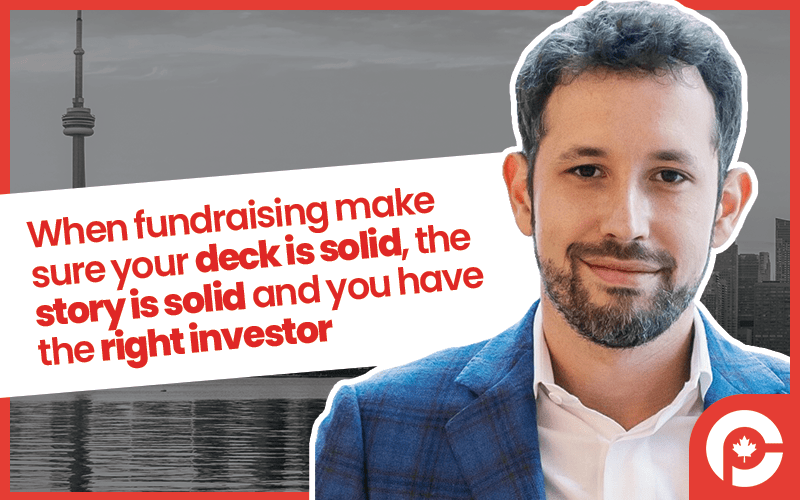
When fundraising make sure your deck is solid, the story is solid and you have the right investor
Episode
Liran Belenzon is the CEO of BenchSci, a biomedical artificial intelligence company he co-founded in 2016. BenchSci’s mission is...
Key takeaways
- Entrepreneurship should only be pursued if you absolutely cannot help yourself, as the journey is rarely fun and carries significant financial, personal, and health risks with a 99% failure rate.
- When fundraising, create urgency by running a compressed process with 15-20 investors over three days rather than building long-term relationships, treating it like a bidding war to maximize leverage.
- Strong conviction with weakly held beliefs is essential, allowing you to pursue a direction with full commitment while remaining smart enough to pivot when necessary.
- Ask yourself annually how you can become unrecognizable in a good way within 12 months, as the skills required to lead a company evolve dramatically at different stages of growth.
- Learn to part ways with people at the right time, especially when performance is mediocre rather than obviously bad, by consistently assessing whether your team is right for the next 18-36 months.
Transcript
Full transcript page · Interactive episode
============================================================
TRANSCRIPTION WITH SPEAKERS
============================================================

[00:00] SPEAKER_02: Welcome to Candace Podcast.
[00:05] SPEAKER_02: Hi everybody, I'm Fulblist, Founder and CEO of Candace Podcast, coming to you today from Toronto.
[00:13] SPEAKER_02: Today we're going to meet Lyrn Boundstone, who's the CEO of Benzvi, a biomedical artificial intelligence company,
[00:21] SPEAKER_02: who co-founded in 2016.
[00:22] SPEAKER_02: Benzvi's mission is to exponentially increase the speed and quality of life-saving research
[00:29] SPEAKER_02: by empowering scientists to design more successful experiments.
[00:35] SPEAKER_02: Benzvi is going to over 300 people and raised more than 200 million from top investors,
[00:42] SPEAKER_02: including Google's Radio Inventures and F-Brime.
[00:45] SPEAKER_02: Benzvi works with 15 of the self-op 20 farmer companies,
[00:50] SPEAKER_02: over 4,300 academic institutions and more than 40,000 scientists.
[00:57] SPEAKER_02: At BL, Lyrn tries to inspire people to be the best version of themselves
[01:02] SPEAKER_02: and to make a positive impact on the world.
[01:06] SPEAKER_02: Lyrn emigrated to Toronto and completed his MBA at the U of T, Rotman School of Management.
[01:12] SPEAKER_02: While at Rotman, he worked at the Creative Dispraction Lab,
[01:16] SPEAKER_02: where he met Benzvi co-founders, Tom Long, David Chen, and Al Elvis Wrabe.
[01:23] SPEAKER_02: As a passionate entrepreneur, Lyrn envies the future where Toronto and Canada are global leaders in entrepreneurship.
[01:34] SPEAKER_02: Actually, I first met Lauren Lyrn about six years ago,
[01:38] SPEAKER_02: when a very young Benzvi won the Brightly and Entrepreneur Awards, which I was managing.
[01:45] SPEAKER_02: It is still good to see that Benzvi has gone so far.
[01:49] SPEAKER_02: So, Lauren, welcome to Canada's podcast.
[01:52] SPEAKER_02: Great to see you. I haven't seen you for a few years,
[01:54] SPEAKER_02: but I'm delighted that Benzvi has moved absolutely along in the right direction
[02:03] SPEAKER_02: that we thought it would have five or six years ago.
[02:07] SPEAKER_02: Before we get too deep in the conversation,
[02:09] SPEAKER_02: I want to tell everyone a little bit more about Lyrn, who you are,
[02:15] SPEAKER_02: how you got here, and what you do at the moment.
[02:20] SPEAKER_00: For sure, that sounds great. And thank you for having me.
[02:23] SPEAKER_00: So, I guess I have a few jobs in husband.
[02:26] SPEAKER_00: I'm a dad to beautiful children, three and five year olds.
[02:31] SPEAKER_00: And I'm a CEO and a co-founder of Benzvi,
[02:35] SPEAKER_00: which is a Toronto-based but pretty much global company that applies AI
[02:42] SPEAKER_00: to really understand how disease biology works,
[02:45] SPEAKER_00: so we can then support scientists to help them develop better, faster and cheaper drugs for patients.
[02:53] SPEAKER_00: And I guess my journey starts, maybe I'll start ten years ago,
[02:57] SPEAKER_00: or more, I moved to Canada. So, I'm originally from Israel, born and raised.
[03:01] SPEAKER_00: That was their channel was 28.
[03:05] SPEAKER_00: So, I finished high school, went to serve at the IDF.
[03:09] SPEAKER_00: And after that, I got a lot of degree and a business degree.
[03:15] SPEAKER_00: And I started two startups there.
[03:18] SPEAKER_00: Didn't really pick off too much. One was reasonably okay.
[03:23] SPEAKER_00: But then ten years ago, I moved to Canada.
[03:26] SPEAKER_00: And the reason I came here was obviously because of a girl
[03:30] SPEAKER_00: that I met.
[03:34] SPEAKER_00: When the hotel was in the back at the hotel.
[03:37] SPEAKER_00: So, we met actually in Southeast Asia.
[03:39] SPEAKER_00: She was traveling between degrees.
[03:42] SPEAKER_00: I was traveling with my army service and my undergrad,
[03:46] SPEAKER_00: which is very common in Israel.
[03:48] SPEAKER_00: And we met in Southeast Asia a few years later,
[03:52] SPEAKER_00: we reconnected at should have been Toronto.
[03:54] SPEAKER_00: We did long business for two years and then wrapped up within Israel.
[03:58] SPEAKER_00: So, my company finished my degree and came here.
[04:02] SPEAKER_00: And I came here under student visa.
[04:06] SPEAKER_00: And I did my MBA at the University of Toronto.
[04:11] SPEAKER_00: And when I moved here, one thing was very clear to me.
[04:15] SPEAKER_00: And it was that no matter what I never wanted to start up again.
[04:19] SPEAKER_00: Because my first experiences was so brutally hard and painful.
[04:25] SPEAKER_00: I didn't know what I wanted to do.
[04:27] SPEAKER_00: And I knew what I wanted to do.
[04:29] SPEAKER_00: And then at the University of Toronto,
[04:32] SPEAKER_00: a drop man, which is their MBA school.
[04:35] SPEAKER_00: There is this startup program for MBA students called the Creative Disruction Lab.
[04:40] SPEAKER_00: In which you, it's a course in which you as an MBA student
[04:46] SPEAKER_00: get your pair to work with a group of scientists who are very smart
[04:52] SPEAKER_00: and have developed some sort of a technology.
[04:55] SPEAKER_00: And together, and it's just a course for you for them, it's real life.
[04:58] SPEAKER_00: You help them figure out how to take that technology idea
[05:02] SPEAKER_00: and turn it into a startup in a company.
[05:06] SPEAKER_00: And I sent up for that course.
[05:09] SPEAKER_00: I don't know why, but I did.
[05:10] SPEAKER_00: And I made this incredible team.
[05:13] SPEAKER_00: And long story short, I ended up joining them as a co-founder and CEO.
[05:19] SPEAKER_00: I just couldn't help it.
[05:20] SPEAKER_00: And that was eight years ago.
[05:25] SPEAKER_00: And today, we've raised over $200 million.
[05:28] SPEAKER_00: We are over 350 people.
[05:32] SPEAKER_00: We work with the majority of the largest pharmaceutical companies in the world.
[05:37] SPEAKER_00: And we developed really incredible technology in a company that makes all of the impact
[05:41] SPEAKER_00: on the global scale every single day.
[05:44] SPEAKER_01: Canada's podcast is your gateway to success in the world of entrepreneurship.
[05:49] SPEAKER_01: Start listening today.
[05:50] SPEAKER_01: Canada's podcast.com subscribe now.
[05:54] SPEAKER_02: So you started off as an entrepreneur.
[05:59] SPEAKER_02: And then you went back to school.
[06:02] SPEAKER_02: Yeah.
[06:02] SPEAKER_02: Over here.
[06:05] SPEAKER_02: So entrepreneurship was Laosie.
[06:07] SPEAKER_02: Went back to it.
[06:09] SPEAKER_02: We haven't seen the bad side.
[06:14] SPEAKER_02: And now the good side.
[06:15] SPEAKER_02: What would you say is best about being an entrepreneur?
[06:28] SPEAKER_00: My perspective on this is a bit different.
[06:33] SPEAKER_00: I don't really try and sell it.
[06:35] SPEAKER_00: I actually do the opposite because 99% of the time it doesn't work out.
[06:44] SPEAKER_00: And we take a lot of risks.
[06:47] SPEAKER_00: Financial, I would say personal, even health wise, because you work to every extent.
[06:52] SPEAKER_00: It's not just a financial risk.
[06:54] SPEAKER_00: Risk on relationships, because you're so committed to it.
[06:57] SPEAKER_00: And it's really consuming.
[06:59] SPEAKER_00: And also from your health perspective.
[07:01] SPEAKER_00: And most of the time mental and physical.
[07:04] SPEAKER_00: And most of the time it doesn't work out almost all the time.
[07:09] SPEAKER_00: So for me, I actually think people shouldn't do it.
[07:13] SPEAKER_00: And I think the only reason people should do it is it was kind of my case, which is you can help not do it.
[07:20] SPEAKER_00: We should bring you that say, you know, this is going to be so much fun and so on.
[07:26] SPEAKER_00: And so on.
[07:26] SPEAKER_00: You just want to turn away and just something inside you that cannot let things go in probably in a obsessive way.
[07:32] SPEAKER_00: That you just feel like you have to do this no matter what.
[07:36] SPEAKER_00: Because some moments are fun, but almost all of them are not.
[07:41] SPEAKER_00: Especially even as the company gets bigger in your quote unquote successful.
[07:47] SPEAKER_00: Because then the problems that you are dealing with are more substantial than when you get started in your small team and you're aware of everything that happens and everything is a big deal.
[07:59] SPEAKER_00: Yeah. Yeah.
[08:00] SPEAKER_00: People ask me early investors or employees, hey, you having fun.
[08:05] SPEAKER_00: And they say it's not a part of the equation from it's to find it's meaningful.
[08:10] SPEAKER_00: In my country, I'm still adding value.
[08:12] SPEAKER_00: And as long as the answer is yes, then that's what drives me.
[08:15] SPEAKER_00: It's not about whether or not I'm having fun or not.
[08:18] SPEAKER_00: I don't think I think almost the entire journey is not fun.
[08:23] SPEAKER_02: You know, what's the greatest challenge you've faced in the business today that you've been able to overcome that maybe you can pass on that experience?
[08:35] SPEAKER_00: Yeah.
[08:36] SPEAKER_00: I think that there being many in different stages of the business.
[08:42] SPEAKER_00: I can talk about a few.
[08:43] SPEAKER_00: So, COVID was one of them where we started when COVID started, we were 50 people in the company.
[08:49] SPEAKER_00: When COVID ended also quote unquote when the lockdown ended in Toronto, which was the city that wasn't long the lockdown the most you went from 50 people to 300 people.
[09:02] SPEAKER_00: Okay, where some of 50 origin 50 left right?
[09:06] SPEAKER_00: So it was pretty much 80 90 90 percent of the company was hard remote setting over the course of two years controlling that operationally culturally was very challenging.
[09:21] SPEAKER_00: When from being in Toronto to the office every single day to have employees all over Canada, over the US and the UK.
[09:29] SPEAKER_00: So how do you unbore people? How do you build a relationship or do you build trust?
[09:34] SPEAKER_00: All the stuff you had to figure out along the way that was one.
[09:38] SPEAKER_00: Two, I would say everything that's even happened right now from an innovation perspective, where genre behind.
[09:44] SPEAKER_00: So for us luckily we've been working this for a while and also we really decided to go all on in a journey but ultimately fast.
[09:51] SPEAKER_00: And that has been a really big game changer for us but not being able to be able to take risks and being agile and move fast is also something that's that's crucial and simple to do.
[10:08] SPEAKER_00: I think on a personal level as the company grows and as it gets bigger as the problems get bigger and the challenges get bigger.
[10:19] SPEAKER_00: I think personally is something that I think I've been working on and I think I should as well just income.
[10:30] SPEAKER_00: Which is very, very important.
[10:33] SPEAKER_00: You know able to manage also disability to compartmentalize is really, really important.
[10:41] SPEAKER_00: You change hats 20 times a day and being able to shop properly in different scenarios is something that's really really important.
[10:53] SPEAKER_00: So that's a thing something it's less about being smart or understanding something or strategic or being a great leader.
[11:01] SPEAKER_00: And just also a lot of kind of personal work you need to do.
[11:03] SPEAKER_00: I just make sure you stay in calm trust in your team and helping everybody including yourself navigate whatever you're going through.
[11:12] SPEAKER_02: So let's look I think one of the things you raise 200 million and obviously there's a lot of learning in that and someone that you know manages like you guys did to find something that really looks like it's going to go in the right direction.
[11:34] SPEAKER_02: Any advice on you know that raised process in terms of what not to do basically and what to do.
[11:46] SPEAKER_00: In terms of which process the scaling the scaling the scaling in terms of the scaling.
[11:54] SPEAKER_02: You know making sure you're well enough funded to scale effectively basically for sure.
[12:00] SPEAKER_00: So for sure it's in the thinking the early days.
[12:04] SPEAKER_00: What you think you're going to end up doing what you're actually doing is two different things.
[12:09] SPEAKER_00: I think it's right.
[12:10] SPEAKER_00: I'm supposed to be like that because as you go learn more information.
[12:14] SPEAKER_00: So this entire concept I personally really believe in it which is strong conviction mostly help is very important.
[12:20] SPEAKER_00: Because you have to go in the direction to go and try something because everybody will not going to work.
[12:27] SPEAKER_00: But you need to be smart enough to know when to let go and not bang your head against the wall because you have to move left or right.
[12:35] SPEAKER_00: That's really important in the beginning.
[12:37] SPEAKER_00: I would argue that's also really important as the business rose.
[12:40] SPEAKER_00: It's probably it's probably done in different speed.
[12:44] SPEAKER_00: But that is very crucial in terms of finding a product market fit.
[12:49] SPEAKER_00: On the fundraising process.
[12:52] SPEAKER_00: I've learned a lot.
[12:53] SPEAKER_00: My first time doing it.
[12:55] SPEAKER_00: I probably did all the possible mistakes.
[12:57] SPEAKER_00: Also I was new to the country.
[13:00] SPEAKER_00: I knew absolutely no one.
[13:02] Speaker UNKNOWN: Work.
[13:03] SPEAKER_00: But it probably took me nine months to raise the first time.
[13:08] SPEAKER_00: That was the first million dollars in the company.
[13:11] SPEAKER_00: Ever since whether it was 20 or 50 or 100 million dollars, it didn't take less than three weeks to do that.
[13:19] SPEAKER_00: And the main reason is that we probably do the exact opposite of the advice that is out there.
[13:28] SPEAKER_00: Which is usually hey, we've got relationships with investors and making sure update them on how things are going.
[13:34] SPEAKER_00: And doctors and many people as you can.
[13:36] SPEAKER_00: And so on and so on and yada and yada yada.
[13:39] SPEAKER_00: We I personally don't talk to investors between rounds.
[13:43] SPEAKER_00: I don't have them about anything that's happened with the company.
[13:46] SPEAKER_00: And the idea is that.
[13:49] SPEAKER_00: What you really are trying to do when you find ways is create a market for a company and create urgency.
[13:56] SPEAKER_00: And you do that by buying a process that is time consumed.
[14:01] SPEAKER_00: That has a lot of or strength or strength and amount of investors.
[14:07] SPEAKER_00: Let's say if you're good at fundraising, you should probably do a fundraising process of 15 to 20 investors that you think they might be good fit to what you do.
[14:17] SPEAKER_00: And you meet everybody on the first kind of three days.
[14:20] SPEAKER_00: Tell them you're fundraising telling me on the process.
[14:23] SPEAKER_00: And you get going and that we're induct rates and urgency in the market.
[14:29] SPEAKER_00: Imagine something along the lines of a beating war on your house if you're selling your house.
[14:34] SPEAKER_00: That's really what you want.
[14:36] SPEAKER_00: Hey, we're doing a lot of showing this when we're taking offers.
[14:39] SPEAKER_00: And so I don't use the exact thing for the process when you fundraise, but that's the concept.
[14:45] SPEAKER_00: And why not build the relationship with investors or give them updates.
[14:49] SPEAKER_00: Because Ionia one chance to make a first impression.
[14:53] SPEAKER_00: It's not going to see any movie.
[14:55] SPEAKER_00: So really when you go in fundraise, you create a deck.
[14:59] SPEAKER_00: And that deck is the book of your company, the story of the company, you move it for company.
[15:03] SPEAKER_00: You want to show it and you want people to have a great experience when they see it.
[15:08] SPEAKER_00: And you don't want to show the shitty versions of it as you're editing it.
[15:12] SPEAKER_00: And that's why the prosimatic, but a prep or basically much fundraise.
[15:17] SPEAKER_00: Make sure that deck is solid, the story solid.
[15:19] SPEAKER_00: Yeah, there are investors in the other room is ready and so on and so on.
[15:23] SPEAKER_00: And then when you meet investors, you tell them a fantastic story and you hit the ground running.
[15:29] SPEAKER_00: The other reason you don't want to build relationships with investors is that they get to see your company in a way that you might not want to share it yet.
[15:41] SPEAKER_00: Or you still figure and stuff out.
[15:43] SPEAKER_00: And or you still working on the story and so on and so on.
[15:47] SPEAKER_00: So that just like puts you in certain buckets and just makes it much harder in the future.
[15:52] SPEAKER_00: Investors will say one idea what I'm saying, but they also have incentive to basically just build relationships because they get more information about you.
[15:59] SPEAKER_00: And there is information which we're many fundraise.
[16:02] SPEAKER_00: And the second thing is their job.
[16:03] SPEAKER_00: The job is to create a funnel of startups and maintain it with helps with one of them, we're transit to investment.
[16:13] SPEAKER_02: The other thing that was kind of interested is, you know, you're in Toronto.
[16:20] SPEAKER_02: You've taken, taken, taken this organization from, you know, a startup to account number, how many 300 plus people internationally.
[16:34] SPEAKER_02: You talked a little bit about that, but you know, what did you learn from that in terms of how to not just scale up, but go international at the same time.
[16:54] SPEAKER_00: I think it's, I think it depends on the context of the business. So for us, we're software company.
[17:00] SPEAKER_00: So naturally, it's not complex because the software you can access and use anywhere.
[17:06] SPEAKER_00: So we have our aspect of logistics, so how do she products?
[17:10] SPEAKER_00: It's one language for everybody. So just some sort of simplicity that allows you to do that.
[17:17] SPEAKER_00: You do have to jump over a lot of planes.
[17:24] SPEAKER_00: It's funny. So when I moved here to become a citizen after your permanent residence, you have to be here three out of the five next five years.
[17:33] SPEAKER_00: You apply for citizenship.
[17:35] SPEAKER_00: And if it wasn't for COVID, I would still not be a citizen because it was traveling so much.
[17:39] SPEAKER_00: So COVID really grounded me, but I travel a ton.
[17:44] SPEAKER_00: And I meet a lot of people around the world and all of customers.
[17:50] SPEAKER_00: And we have, we have customers in Europe and US and Japan.
[17:56] SPEAKER_00: And I think it's just one.
[18:03] SPEAKER_00: When you break it down to kind of first principles, the value and how you pay attention.
[18:08] SPEAKER_00: So that's pretty much similar where the nuances come in is understanding different cultures.
[18:13] SPEAKER_00: European or British cultures, a different American and how to either room.
[18:17] SPEAKER_00: And what are people are saying? What does it mean? I have interpreted how to do business in different organizations and understand the tempo of a French culture and so on.
[18:25] SPEAKER_00: Each of them is just very different.
[18:28] SPEAKER_00: That's something that thinks valuable, but honestly, I think things sometimes just sound more complicated than they actually are.
[18:36] SPEAKER_00: Even when I hear and I guess it sounds complicated, we global company and people everywhere and customers.
[18:44] SPEAKER_00: It works. There's some simplicity in our business. It's really, really hard and challenging and complex to build a technology, but it's very much scalable.
[18:51] SPEAKER_00: I think maybe that's the point. If you build something to scale everything afterwards become very, very easy, which is how we build a company to start.
[18:59] SPEAKER_00: If we're a different type of business that had to set up shop, it would be city to scale and trends in many different languages and operating different ways in different country.
[19:08] SPEAKER_00: Very, very different story and level of complexity. We unfortunately don't have those challenges.
[19:13] SPEAKER_01: Stay ahead of the game with our expert tips and strategies that will help your business thrive in a digital era.
[19:20] SPEAKER_01: Canada's podcast.com subscribe now.
[19:23] SPEAKER_02: Let's talk a little bit about mentorship.
[19:28] SPEAKER_02: What's the best piece of advice that you've been given?
[19:35] SPEAKER_02: You keep, it's always there in the back of your mind as you progress through things.
[19:43] SPEAKER_00: Then there are a few. Some came from books, some came from mentors, some came from smart people and made a longer way.
[19:52] SPEAKER_00: One of the things is keep asking yourself, are you a learner or a nor?
[19:58] SPEAKER_00: Which means you think you know it all or you're talking about it from other people regardless if they work with you, you're their manager, above you decide with or whatever it is.
[20:08] SPEAKER_00: It's just kind of a fundamental question of how do you show up?
[20:14] SPEAKER_00: That one I really like. I'm a learner. I try to be as much as a learner as I can.
[20:20] SPEAKER_00: The second thing I got advice from another Sierra founder, which I really like, which is more of a process that he does, which is every year he sits down and asks himself, how am I unrecognizable in a good way in 12 months from now?
[20:37] SPEAKER_00: And that's what guys into circles for himself, understand what's going to make a version of himself that he wants to be.
[20:44] SPEAKER_00: For me, every year, I'm a different type of CEO of my evolution and the founder per person you got.
[20:54] SPEAKER_00: And it's a very different skill set when you're four people, when you're 100 people, 50 to 100, 300, 400, this stage, a stage, b stage and all the other letters, it's just a very different skill set.
[21:07] SPEAKER_00: So I'm staying tuned to that and making sure you're.
[21:12] SPEAKER_00: Earn your spot every single day is just something I personally believe in. I think it's really important.
[21:18] SPEAKER_02: It's good. That's really good actually.
[21:23] SPEAKER_02: You know, similar kind of idea.
[21:30] SPEAKER_02: If you know what you know now, you know, what you wish you'd known when you started the business in terms of something, something, oh my god, if I'm.
[21:46] SPEAKER_02: If I know that at the beginning of the stage myself, it's from management of pain.
[21:52] SPEAKER_00: Yeah. So specifically for the business and I think there's some sort of Navy day for founders, if I knew what I knew now, I wouldn't start a company.
[22:05] SPEAKER_00: It's too much. Too many things had to fall into the right place for this to be successful.
[22:15] SPEAKER_00: Just too many.
[22:16] SPEAKER_00: So would you say the people don't become an entrepreneur?
[22:20] SPEAKER_00: It's not about entrepreneurs say, do it and as you.
[22:22] SPEAKER_00: Do you feel like you just cannot not do it that do that terms of even the specific company our company?
[22:31] SPEAKER_00: Because when you go into it, especially the, obviously, if you're founder, you're probably an optimist because you think things can work out.
[22:40] SPEAKER_00: And you probably underestimate the challenge of doing certain things or just stuff things just don't know that have to fit and work out for your company to be successful.
[22:51] SPEAKER_00: So everything in the know now, after eight years in it, I would probably say there's no way this can succeed.
[22:57] SPEAKER_00: There's too many things that have to go exactly right for this to succeed.
[23:02] SPEAKER_00: So we made it happen probably more than anything.
[23:05] SPEAKER_00: There's that. But if there's something I wish I knew to do better going into this is probably two things, one find ways.
[23:14] SPEAKER_00: Because well, we did get good at that probably a B stage would have say probably a year of work at the early stage.
[23:21] SPEAKER_00: So that was really on the court advice. I just kind of share the second thing is better at.
[23:33] SPEAKER_00: Harding ways with people at the right time.
[23:37] SPEAKER_00: And when it's obvious it's easy.
[23:40] SPEAKER_00: When it's just not working, terrible, that's easy. When it's in the mail, it's really hard.
[23:45] SPEAKER_00: And that's what's also hard to do about my job and I'm sure the board has the same job, by the way, with me, which is.
[23:51] SPEAKER_00: Do we have the right people for the next to 18 24 36 months right now, because that's what you want to judge them on when in 36 months, hopefully this company is twice the size of three times the size.
[24:03] SPEAKER_00: And then you have to do the same assessment again on those the right people that time, maybe the group, maybe the army, be or not, which accounts feel so your daughter, your team and figure out who's ready for now is where for the future.
[24:13] SPEAKER_00: As I'm sure the board does it with me as the CEO am I right for now? I'm right for the future as they should.
[24:18] SPEAKER_00: But it's come it's something that's inherent in startup that go well and scale and scale up because the job you have today and the job you might have in three years, it might be two complete different jobs.
[24:30] SPEAKER_02: Think about it. If you weren't doing what you're doing now, what would you be doing instead?
[24:38] SPEAKER_00: Well, it depends do I have to work or I don't know you tell me.
[24:47] SPEAKER_00: If I'm retired, I would honestly spend all time with my family, I'll be on the kids, I spent time with my kids and wife as much as possible.
[24:58] SPEAKER_00: But knowing myself or probably just starting something fairly fast because one of my problems is that once I see something ahead of having an idea of this absolutely insane sense of urgency to bring it to life.
[25:13] SPEAKER_00: And in an obsessive manner, I would argue my wife suffers from that quality of mine. It's great for startups.
[25:23] SPEAKER_00: It's great when you're doing a lot of this installation ship and I even across the ocean to be with your girlfriend.
[25:31] SPEAKER_00: But there's that aspect.
[25:34] SPEAKER_00: Yeah, I think this is kind of what I'm wired to do to be honest with you.
[25:38] SPEAKER_00: I love bringing things to life. I just love.
[25:42] SPEAKER_00: I can't.
[25:43] SPEAKER_02: I know that. I get that.
[25:47] SPEAKER_02: What book you can't be reading or podcast listening to or maybe more what book would you recommend to the audience?
[25:57] SPEAKER_02: I'm going to give you all the about.
[25:59] SPEAKER_00: So I don't read books. I listen to books because I don't really have time to read.
[26:05] SPEAKER_02: Okay, that's fine. I understand.
[26:07] SPEAKER_02: You and many others.
[26:08] SPEAKER_00: Yeah, so I listen to a lot of books and the only books that I listen to are business books and I love business stories.
[26:15] SPEAKER_00: So I also be fell in love with podcast called acquired.
[26:20] SPEAKER_00: I think it's a number one podcast in the States right now. It's basically every show.
[26:27] SPEAKER_00: It's like four hours on and it takes a company and it just analyze it and tells the story of the company from their want of today.
[26:34] SPEAKER_00: So thinking Microsoft Amazon over Nordisk and many others.
[26:40] SPEAKER_00: And I also love it. So basically every episode is a book.
[26:44] SPEAKER_00: That's a podcast in terms of some books. I love.
[26:48] SPEAKER_00: Shudog hard things about hard things zero to ones in excellent book.
[26:57] SPEAKER_00: I want my favorite books actually is not a business book. It's called Open by Andrea Agassi and don't have to be a tennis fan to like that books.
[27:05] SPEAKER_00: Probably one of the best books ever listen to your red in my life.
[27:10] SPEAKER_00: The conscious business I think is a book that probably not a people are about but also an excellent book.
[27:17] SPEAKER_00: Yeah, those are some examples.
[27:20] SPEAKER_02: Good reading list for people or listening list.
[27:24] SPEAKER_02: Are you a morning or a night person?
[27:27] SPEAKER_00: I know. I wake up at 4.45 everything.
[27:30] SPEAKER_02: Oh wow. Pretty early.
[27:34] SPEAKER_02: And learn if you had to pick one word to describe yourself.
[27:38] SPEAKER_02: What would it be and why would you choose it?
[27:42] SPEAKER_00: I give it the why first and not the word.
[27:44] SPEAKER_00: Why? Because this is what everybody else say when the probably to describe me one word.
[27:50] SPEAKER_00: Even though I don't think it's true, but I guess it is because people say it and that word would be intense.
[27:59] SPEAKER_02: What's keeping up at night?
[28:02] SPEAKER_02: Make it apart from that. I suspect you say that.
[28:11] SPEAKER_00: Maybe we could something else.
[28:13] SPEAKER_00: It's personal.
[28:15] SPEAKER_00: So as I mentioned to your mom originally from Israel.
[28:18] SPEAKER_00: So I reckon it's happening there and my family there.
[28:20] SPEAKER_00: Yeah, you can understand that.
[28:23] SPEAKER_00: So that's which kind of goes back to compartmentalizing.
[28:27] SPEAKER_00: After work, whether it's technology, customers, team members.
[28:34] SPEAKER_00: Every week is something else I care deeply.
[28:38] SPEAKER_00: I know a lot of things happen in the company.
[28:40] SPEAKER_00: I won't understand what's working with not so I can support the team.
[28:43] SPEAKER_00: And every time something else would be a big launch.
[28:46] SPEAKER_00: It can be a big deal with the customer.
[28:49] SPEAKER_00: It can be something that's happening around people.
[28:53] SPEAKER_00: It can be my kids, but it really changes.
[28:57] SPEAKER_00: That's that's a dynamic part of it, I guess.
[29:00] SPEAKER_00: I have noticed it's better to be honest, which I think is really important.
[29:04] SPEAKER_00: I'll try not to check my phone just before I go to bed.
[29:09] SPEAKER_00: So don't see that email that keeps me up all night.
[29:11] SPEAKER_00: Because something just happened.
[29:14] SPEAKER_00: I think.
[29:16] SPEAKER_00: Showing up properly.
[29:19] SPEAKER_00: Becomes more and more and more important as the company grows.
[29:25] SPEAKER_02: We're hitting our time.
[29:28] SPEAKER_02: I kind of like to do 30 minutes.
[29:31] SPEAKER_02: How can people get a whole new learn as they start stuff and they want to get some input?
[29:40] SPEAKER_00: For me, they can shoot me an email.
[29:42] SPEAKER_00: My email is.
[29:43] SPEAKER_00: L.I.R.N.
[29:45] SPEAKER_00: At Benz Say that.
[29:46] SPEAKER_00: Come.
[29:47] SPEAKER_02: Okay.
[29:49] SPEAKER_02: It's been great seeing you again.
[29:51] SPEAKER_02: I really have enjoyed it and great to see what you've done with Benz Say.
[29:56] SPEAKER_02: Loved it.
[29:57] SPEAKER_02: Okay.
[29:58] SPEAKER_02: So much.
[29:58] SPEAKER_02: I appreciate it.
[29:59] SPEAKER_02: Thanks for having me.
[30:01] SPEAKER_02: I'm Fodlis.
[30:03] SPEAKER_02: Don't forget to subscribe to our newsletter on our website and also subscribe on YouTube.
[30:10] SPEAKER_02: Thanks for listening to Canada's podcast where you get to meet the entrepreneurs that drive Canada's economy.
[30:17] SPEAKER_02: Stay still.