
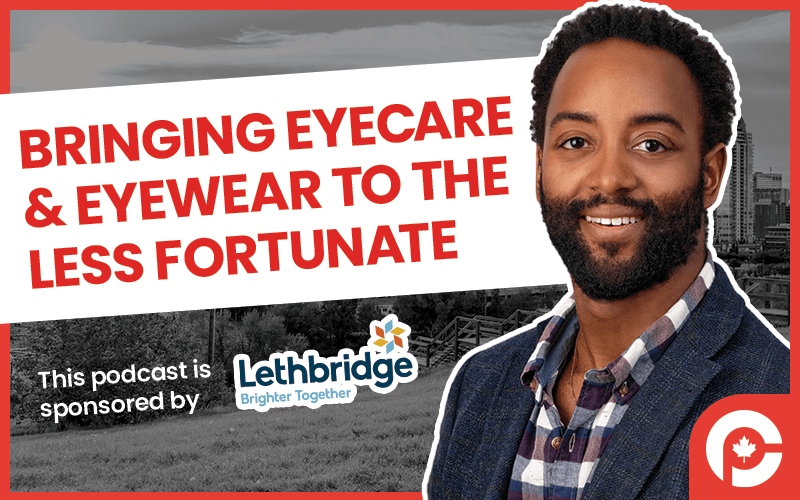
Dr. Emeka Nzekwu is bringing eyecare and eyewear to the less fortunate
Episode
Dr. Emeka Nzekwu is CEO and Founder of Nation’s Vision, a grassroots portable optometry clinic based out of Calgary...
Key takeaways
- Healthcare disparities exist for marginalized populations not just because of disease, but due to multiple socio-economic barriers that prevent them from accessing care through traditional healthcare system designs.
- Bringing portable healthcare services directly to where underserved populations are—such as schools, shelters, and immigration centers—can bridge the gap for those who fall through the cracks of conventional healthcare delivery.
- Recognizing your own limitations and actively seeking collaboration with people who have different skill sets is essential for entrepreneurial success, just as it is in multidisciplinary medical practice.
- Passion-driven entrepreneurship requires finding time outside your primary career by prioritizing what matters most, even when balancing demanding professional responsibilities like medical practice.
- The hardest part of entrepreneurship is balancing the desire for independence with the necessity of asking for help, while ensuring you maintain high standards and don't compromise the quality of service for your clients.
Transcript
Full transcript page · Interactive episode
============================================================
TRANSCRIPTION WITH SPEAKERS
============================================================

[00:01] SPEAKER_00: Come to Lethbridge and join an innovative community for entrepreneurs.
[00:06] SPEAKER_00: With more than a quarter of the 100,000 population under the age of 34, Lethbridge brims with
[00:12] SPEAKER_00: energy.
[00:13] SPEAKER_00: We'll help you to kickstart, innovate, and grow.
[00:17] SPEAKER_00: Lethbridge Southern Alberta's help for innovation and technology.
[00:21] SPEAKER_00: It's the bright choice for business builders.
[00:24] SPEAKER_00: Go to chooselethbridge.ca slash entrepreneur and we'll help you move and grow in Lethbridge.
[00:32] SPEAKER_02: Welcome to Canada's podcast.
[00:38] SPEAKER_02: Hello and welcome to Calgary's podcast with Mario Toneguzi on Canada's podcast network.
[00:44] SPEAKER_02: Joining me today is Dr. Ameka Enzeku, who is the founder and CEO of Nations Vision in Calgary.
[00:53] SPEAKER_02: Thanks for joining us today.
[00:55] SPEAKER_01: Thanks for having me.
[00:56] SPEAKER_02: Well, let me just start by asking you what Nations Vision is and what you guys do there.
[01:04] SPEAKER_01: Yeah, for sure.
[01:05] SPEAKER_01: So Nations Vision is a subsidiary of Nations Health, which is an overarching larger organization that is designed and determined to provide portable healthcare services for
[01:23] SPEAKER_01: priority populations, underserved populations, marginalized populations, locally within Canadian communities.
[01:29] SPEAKER_01: And we started in Calgary.
[01:31] SPEAKER_01: Nations Vision is the optometry of themology and optical arm of Nations Health.
[01:38] SPEAKER_01: And it is dedicated to the provision of affordable, equitable eye care services for priority populations.
[01:46] SPEAKER_01: And so on a nutshell, we provide at this current time in phase one portable services.
[01:52] SPEAKER_01: So we provide services directly into low income schools directly into immigration centers, newcomers centers, homeless shelters, and so forth.
[02:03] SPEAKER_01: And we provide and seeing homes as well.
[02:04] SPEAKER_01: And that's where we provide most of our eye exams.
[02:07] SPEAKER_01: And then we have a portable optical arm, which provides services basically anywhere, even in people's private homes, providing
[02:15] SPEAKER_01: glasses and contacts and eyewear solution directly to anybody who needs them, wherever it is that it's possible to give it, get it to them at an affordable price.
[02:26] SPEAKER_02: When did you start this?
[02:28] SPEAKER_01: So Nations Vision was started in 2019.
[02:32] SPEAKER_01: And originally we first started by going to Calgary Immigrant Women's Association, which is Immigration Agency.
[02:41] SPEAKER_01: And we provided services there for free for about 142 immigrant women.
[02:47] SPEAKER_01: And that's what we started it with.
[02:50] SPEAKER_02: And give me some of the background of why you started this and you know how this came about.
[02:56] SPEAKER_01: Yeah, so as a physician, I've kind of had quite a prolonged period of time where I've noticed some healthcare disparities, some severe healthcare disparities amongst Canadians, particularly involving priority populations, understate population, marginalized population.
[03:14] SPEAKER_01: And the reason why in a quick nutshell is, oh, there's multiple factors, but one of those multiple factors is that the social determinants of health, the people talk about it all the time, social determinants of health are basically multiple different socio-economic determinants and factors that affect one's health.
[03:34] SPEAKER_01: It's not simply just, you know, oh, I have a disease. Now I have this problem. Now I have to get it fixed. I have to go see a doctor. It's multiple factors.
[03:40] SPEAKER_01: And so there's multiple barriers for those individuals to access adequate healthcare solutions and services.
[03:48] SPEAKER_01: And so what I noticed in from a medical standpoint is we catch a lot of people who have fallen through the cracks in our system.
[03:56] SPEAKER_01: Our system is designed one way.
[03:57] SPEAKER_01: We provide a solution to those individuals. And then when that solution doesn't necessarily work for them, or if that specific design doesn't necessarily work for them to enter into a healthcare system or access services, they tend not to, or they, when they do tend to, they tend to end up accessing the system at a point where it's a little bit prolonged with a disease process, or whatever is reflecting them is a little bit at a higher stage.
[04:22] SPEAKER_01: And so that's why I decided to create nation's vision and nation's health to try to improve access to care, find people where they're at and get them access to healthcare services.
[04:35] SPEAKER_01: However, that may be whether that's bringing the service directly to them or decreasing the cost for them or what have you.
[04:41] SPEAKER_02: So tell me a little bit about the locations. Are you just in Calgary right now or.
[04:49] SPEAKER_01: Yeah, so right now we're just in Calgary.
[04:52] SPEAKER_01: We've been slowly looking to see what other cities have to offer currently because obviously every city is kind of different in the programs that they have to offer their, you know, their local populations and local underserved groups and so forth.
[05:08] SPEAKER_01: They're all very, very different across Canada. We know we're going to try to first expand across Alberta and ensure that we provide solutions there. And then of course there's definitely other locations across Canada for us to provide service.
[05:21] SPEAKER_01: So we're really hoping to partner with a lot of agencies partner with what people are currently doing right now connect with different businesses and offer profits and charities and ensure that we're able to provide solutions for their clientele and our future patients.
[05:38] SPEAKER_01: So what's your background doctor and right?
[05:41] SPEAKER_01: So I am an interventional radiologist.
[05:45] SPEAKER_01: It's my fellowship actually in my fellowship right now just what we finished out here in Halifax, but I was born and raised in Calgary and did an engineering out at UBC and medical school at U of A and residency in Calgary and here I am now in Halifax and.
[06:03] SPEAKER_01: I hope to come back out west at some point and we'll see whatever happens, but at the end of the day this is this is definitely nations health is definitely a passion of mine and it's from, you know, from a small business kind of sound point entrepreneur kind of sound point.
[06:18] SPEAKER_01: It's just like a career passion. That's this is what I love to do.
[06:21] SPEAKER_02: So what's your what got you into medicine?
[06:27] SPEAKER_01: So I actually went from engineering I always wanted to end up seeing if I was away to bridge healthcare and engineering because there's, you know, there's a lot of bridges to that gap with black people already already done that technology plays a huge role in medicine.
[06:45] SPEAKER_01: And the advancement of technology have played a huge role in the improvement of patient care and I've always wanted to be able to be engaged with patients and healthcare and design and so I'll ended up.
[06:58] SPEAKER_01: The client wanted to help people and I knew I always wanted to help people even as an engineer and this is this is definitely a way to get right into it and help people exactly with your hands on a daily basis.
[07:10] SPEAKER_01: Doing what I do and I love it.
[07:14] SPEAKER_00: Tech Connect, a center for entrepreneurship and innovation and let bridge has been spring-boarding entrepreneurs to success for 10 years and counting.
[07:23] SPEAKER_00: Our spirit of innovation is a way of life. We have an incredible environment.
[07:29] SPEAKER_00: Our innovators are not afraid to stand apart because they know that in let's bridge we are brighter together.
[07:35] SPEAKER_00: We are let bridge come and join us go to choose let bridge dot c a slash entrepreneur and we'll help you move and grow in let bridge.
[07:47] SPEAKER_02: So you mentioned the passion for this where does that passion come from for this particular area and this.
[07:54] SPEAKER_02: For nations health.
[07:55] SPEAKER_02: Yeah, and for the need for for something like this.
[07:58] SPEAKER_01: Yeah, so I think that passion kind of came from my own personal experiences family members, family friends, community members that I've seen.
[08:11] SPEAKER_01: Either become afflicted by disease and or pass away on their own sorry from medical conditions that were actually quite.
[08:21] SPEAKER_01: From a Canadian context you're from born and raised in this country were quite curable or quite preventable.
[08:28] SPEAKER_01: Yeah, but not for me was quite difficult to see and you know over time when you really get a chance to take a look and take a step back and think about it is like why did that occur and why did this happen and.
[08:40] SPEAKER_01: You know you come to some solutions and to some conclusions and I feel like once again it's it's a you know not necessarily a cookie cutter system that might not necessarily always fit the need for everybody.
[08:53] SPEAKER_01: There's a large percentage of Canadians that are are affected by this you miss matching the design of our healthcare system as a whole not talking about just the medical system talking about all factors whether that's a geometry dentistry physiotherapy, chiropractic therapy medical.
[09:09] SPEAKER_01: There be pharmacy all of those different factions are face the same problem and they present the same kind of solution for patients that doesn't necessarily fit everybody.
[09:19] SPEAKER_01: And unfortunately when people fall through the cracks.
[09:23] SPEAKER_01: It affects their lives and affects their livelihoods the quality of their life and the longevity of their lives to you so.
[09:29] SPEAKER_02: So what you know as a as a doctor what do you find a time to do a side show so to speak and being an entrepreneur.
[09:42] SPEAKER_01: So I get that question quite a bit.
[09:45] SPEAKER_01: You kind of just put you have to have your priorities and you know a lot of people have always said you know you if you want to do something and you you'll find the time to do it and you know you have to focus on it and.
[09:58] SPEAKER_01: And this is my passion so I mean for me it's I don't even feel like it's a time consuming endeavor.
[10:06] SPEAKER_01: I do it after hours I'm here in the hospital right now and.
[10:10] SPEAKER_01: You know you caught me on the way out and I was just trying to get try to get myself home and uncomfortable and then but yeah that's that's how it works you know I mean I got a.
[10:19] SPEAKER_01: You know do things after work take the time to you know pursue these passions and they are related right I mean I'm a position here and I do intervention realities kind of a surgical kind of.
[10:32] SPEAKER_01: Crossroads between surgery and intervention reality but you know it's related I'm involved in trying to improve care access to care for patients.
[10:41] SPEAKER_01: And in the end of the day when a patient sees me here in the hospital they've already transgress multiple levels of primary care so it's like I am seeing them at the end and then I see them trying to help them at the beginning.
[10:57] SPEAKER_01: Yeah you know so that they don't have to see me at the end of it so what do you like about being an entrepreneur.
[11:06] SPEAKER_01: So to be 100% positive I don't have any actual background in entrepreneurship or business or anything you know I mean I just really I quickly realize this is this is something that needs to get done and how do I best do this you know I got started company got to start a business I got a creative business mod I got to do all this kind of stuff.
[11:25] SPEAKER_01: One thing I really love about being an entrepreneur is recognizing the limitations of your own knowledge recognizing the limitations of my experience and my education you know engineering how care doesn't train you to become a business entrepreneur or what have you however it.
[11:46] SPEAKER_01: It allows me to use something that I've learned a lot which is in medicine I've learned a lot about collaboration and multi disciplinary work and you know leaning on other people who have skill sets in other areas to get the job done and you know be that an intervention we all just do his nurses and his tax has heard of nurses and his tax.
[12:12] SPEAKER_01: That's that kind of collaboration whereas in business I'm leading on marketing and running on my promoters I'm leading on my accountant and lawyers and leading on all the partners that are involved whether that school districts or not for profit CEOs and CEOs like it's that engagement which I love and that's what I find the best honest part.
[12:31] SPEAKER_02: Okay, super what's the toughest thing about being an entrepreneur for you.
[12:37] SPEAKER_01: Toughest thing about being an entrepreneur easily I think is.
[12:42] SPEAKER_01: I think what I think one of the hardest things that I've come to recognize is also on that same point is recognizing your limitations and realizing that.
[12:52] SPEAKER_01: And you can't do it on your own realizing you constantly have to ask for help realizing you have to lean on everybody even though you've loved to have that kind of independence to kind of push through and recognizing at the end of the day the last thing you want to do that was hurt somebody the last thing you want to do is make things worse for the patient population to clientele that we serve.
[13:13] SPEAKER_01: And so it's trying to be a perfectionist at the same time is trying to get things done and having that kind of balance of making sure that you can get things done at the same time is do them properly.
[13:27] SPEAKER_02: Yeah, so being a doctor being an entrepreneur does that give you any time for anything else.
[13:36] SPEAKER_02: I think so.
[13:38] SPEAKER_01: I like to think so.
[13:40] SPEAKER_02: What kind of things you like doing.
[13:42] SPEAKER_01: Well, you know, hiking, you know, being from Calgary being from the prairies I loved hiking being out in the mountains, camping with friends.
[13:51] SPEAKER_01: Really enjoys paying time with my family and going out to restaurants, particularly in Halifax, great restaurants, great bars.
[14:00] SPEAKER_01: I've enjoyed I've enjoyed my time here in Halifax quite a bit and people are great and I enjoy Spain time with people.
[14:06] SPEAKER_01: Okay, super then.
[14:07] SPEAKER_02: All right. Well, thanks for joining us today.
[14:10] SPEAKER_01: No, well, thank you so much for having me.
[14:11] SPEAKER_01: I really appreciate it and glad that you would consider having me onto your on your podcast and talk to you about nation's health talking about nation's vision and being an entrepreneur.
[14:22] SPEAKER_02: All right, super.
[14:22] SPEAKER_02: That was Dr. Amika and Zeku, who is the founder and CEO of nation's vision here in Calgary.
[14:31] SPEAKER_02: This has been Calgary's podcast on Canada's podcast network with Mario Tonoguzzi.
[14:36] SPEAKER_02: Thanks for joining us today.
[14:38] SPEAKER_00: Bold, vibrant, technological.
[14:42] SPEAKER_00: In Let's Bridge, our spirit of innovation is more than just the way we do business.
[14:47] SPEAKER_00: It's the way we live and the way we succeed.
[14:51] SPEAKER_00: We'll help you to kickstart, innovate and grow in Let's Bridge.
[14:55] SPEAKER_00: Southern Alberta's hub for innovation and technology.
[14:58] SPEAKER_00: It's the bright, affordable choice for business builders.
[15:02] SPEAKER_00: Go to chooseletthbridge.ca slash entrepreneur and we'll help you moving rolling Let's Bridge.